
 Updated : July 7, 2026
It’s Friday evening. A prospect fills out your demo form.
While your team is unavailable, a competitor’s AI agent calls her. By Monday, she’s on their calendar.
Your SDR sees the lead, dials, voicemail. The deal is already moving without you.
Now multiply that by every after-hours and weekend lead in your funnel last month. That’s the pipeline your competitor is quietly closing while your dashboard still says “lead captured.”
Your forecast won’t catch it for another quarter. By then, those deals are closed lost. You never knew they were in play.
Close the gap between lead and first call, and most of those deals are yours.
What Just Cost You the Demo
Look at what happened between Friday evening and Monday morning. The gap didn’t open because your team was slow. It opened because four things were working against them at once.
None alone would lose the demo. All four together do.
- Coverage: Every lead needs a call, fast, no matter when or where they sign up. A nine-to-five team can’t keep up. Leads that come in after hours have the steepest intent decay. They’re also the hardest to catch.
- Consistency: Every call needs to follow the same playbook. Same opening, same objections, same booking flow. Humans can’t do this. They have off days, and scripts drift within a quarter.
- Scale: Volume doesn’t grow neatly. A team running 50 leads a week buckles at 500 across three personas. More SDRs is expensive, slow to onboard, and turns over inside 18 months.
- Capture: Every conversation needs to land in your CRM with notes, disposition, and next step. Most teams lose this between the call and the keyboard.
Get one wrong and the funnel leaks. Get two wrong and forecasted demos don’t book.
So what’s the real fix? It starts with how you pay for solving all four.
Pay for the Outcome, Not the Stack
Right now you’re paying for minutes your agent spends on the phone, or seats your team logs into. Neither number tells you whether a single demo got booked.
You’re buying activity and hoping it turns into outcomes.
For AI voice agents, the call itself isn’t the binding constraint anymore. The outcome is.
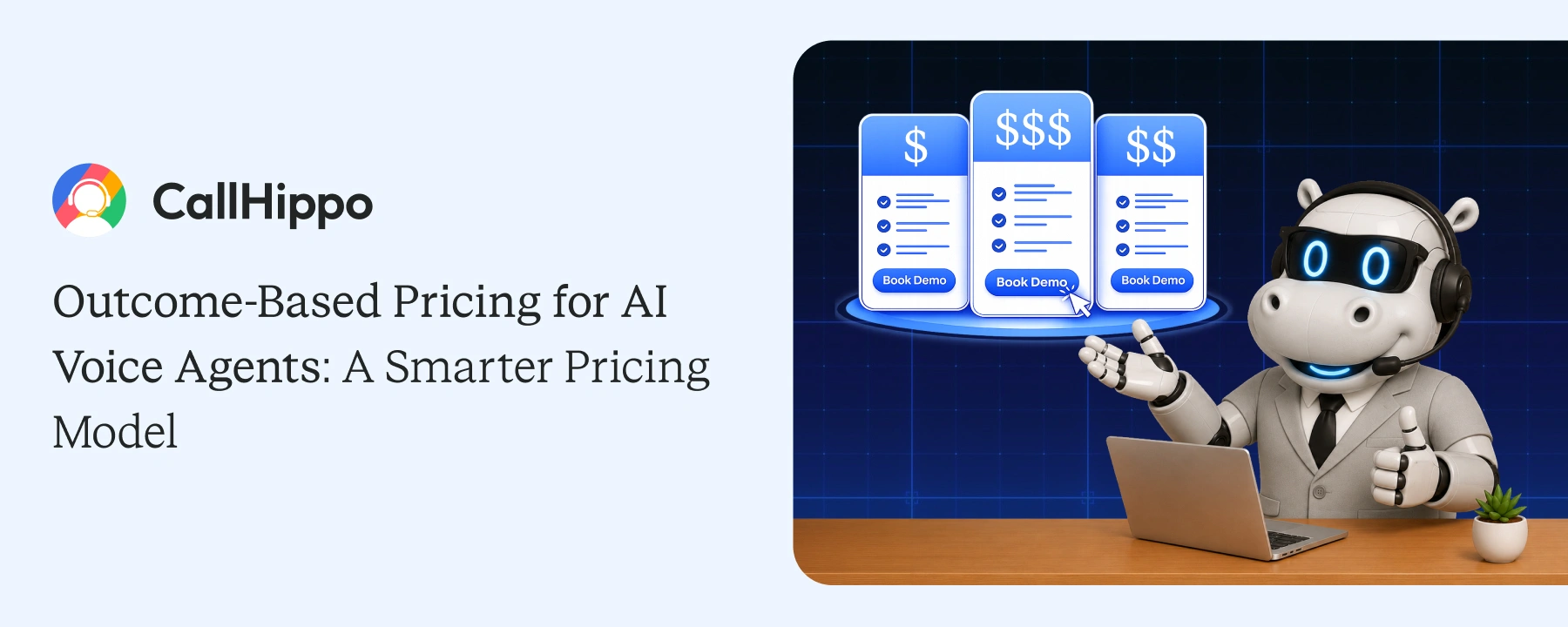
Outcome-based pricing matches the bill to the result. You pay only when a demo lands on your calendar.
- Zero risk for the buyer: If the demo doesn’t book, the line item doesn’t exist.
- Built-in accountability: More demos, qualified properly, booked faster. Same goal on both sides.
- No surprise costs: No setup fee. No per-call charge. No seat license.
- Predictable cost-per-demo: You know what each booked demo costs before it lands.
This isn’t a discount. It’s a different financial relationship. Under per-minute pricing, the vendor gets paid whether you win or not. Under outcome-based pricing, only when you do.
So why isn’t outcome-based pricing the default already?
Because most vendors aren’t built to deliver on it.
What Happens When You Try to Build It Yourself
Outcome-based pricing only works if the vendor is responsible for the outcome. Most AI voice products aren’t.
The instinct, naturally, is to fix this yourself. Build the agent. Wire up the calls. Catch the next one before Monday.
In 2026, the technology exists to do exactly that. Vapi has a flexible voice agent platform. Twilio has carrier-grade phone infrastructure. A small engineering team can wire it all up.
On paper, it works.
Then reality arrives.
Six weeks in, the picture looks different. The agent is the easy part. Everything around it isn’t. Three things compound:
- The build: Provision Twilio numbers. Configure SIP routing. Build prompts from scratch. Integrate the agent into your CRM. Hook it up to your calendar. Set up retry logic, voicemail detection, and compliance. Reconcile per-minute spend across two billing meters. Days to weeks of engineering before a single call goes out.
- The maintenance tax: Every pricing change, feature ship, and new objection requires retraining the agent. The version that worked in January is out of sync by March. It isn’t a one-time setup. It’s a standing item on someone’s plate.
- The scale problem: A DIY agent works at 50 leads a week with one persona. At 500 leads across three personas, prompt logic, routing, and maintenance compound. The system needs a dedicated owner. Which is exactly the headcount you were trying to avoid.
Vapi and Twilio both work as priced. But neither can credibly bill you only on outcomes. Because neither is responsible for those outcomes. That sits with you and your engineering team.
The category needs a different model. One where the work, and the accountability for the result, sits with the vendor.
What Would Have Made the Difference
So what would have caught her at 9:14 p.m.?
The category shift isn’t AI voice agents as a tool. It’s AI voice agents as a fully managed service, with the phone infrastructure built in.
Here’s what that means in practice:
- Every lead, called within minutes: Every inbound lead gets a call within minutes of signup. Regardless of time, day, or geography. Intent is caught at its peak, not after it has decayed.
- The same playbook, run on every call: Every call runs the same qualification flow. The vendor builds and maintains the flow: opening, discovery, objection handling, booking. Kept current as your messaging changes.
- Volume scales without headcount: The same agent handles 50 leads a week or 500. Add a persona, a product, a region, none of it requires new SDRs.
- Every call captured in your CRM, automatically: Every conversation lands in your CRM with the disposition, the notes, and the next step. No SDR forgetting to log. No gap between call and pipeline.
The build, the maintenance, the integration, the phone infrastructure: all handled by the vendor. Your team’s job is to show up for the booked demo.
If all this sounds idealistic, it should. We’re a vendor making this claim. So here’s how we actually got there.
How We Got Here
A few years ago, we noticed something strange in our own funnel.
Marketing was doing its job. Demo requests climbed. The pipeline looked healthy.
Revenue looked ordinary.
Our first instinct was the same as every other SaaS founder’s. Hire another SDR. Then another. Then split the team across time zones.
Nothing really changed.
So we built an AI Voice Agent of our own. Just to take the first touch. And the result surprised us.
Not because it was a better conversationalist than our reps. It wasn’t.
Because it was first to every lead. Every time. Every shift.
We rolled it out to a small group of customers in beta. The pattern held. That’s when we knew it wasn’t a quirk of our setup.
The fully managed model, priced on outcomes, changes what a SaaS team can do. All without adding headcount.
Want to see what that looks like for your own funnel? That’s exactly what CallHippo’s AI Voice Agent is built for.
 :
:Be the First Vendor on the Phone
CallHippo’s AI Voice Agent closes the gap between leads captured and demos booked. Unlike multi-vendor setups that integrate Vapi with Twilio and your CRM, we set up the AI Agent for you. Calling, VoIP, phone infrastructure, all built in.
All you or your SDRs have to do is close more deals.
One platform. One onboarding. One bill.
Here’s the value it brings to your demo pipeline:
- AI Voice Agent + calling + VoIP, in one platform: No Twilio account. No SIP routing. No three-tool stack to maintain.
- Fully managed deployment: We build the agent, tune it for your offer, and keep it current as your messaging evolves.
- Every lead called in minutes, 24/7: No queue. No backlog. No leads waiting until Monday.
- Every conversation captured in your CRM automatically: Disposition, notes, and next step. No SDR forgetting to log.
- Pay only when a demo books: No setup fee. No per-call charge. No seat license.
Try it free, side-by-side with your current SDR process.
We’re offering a free POC. Plug it into your existing flow. Measure the impact on your demos. Compare what changes.
No commitment. No setup fees. Just real data showing whether this works for your funnel.

Try CallHippo's AI Voice Agent to connect faster and close better.
Get Free Proof of Concept No credit card required!Published : July 7, 2026

Ankit Dudhwewala is the CEO and Co-founder of CallHippo, a leading virtual phone system designed to optimize business communication through AI and automation. With a strong background in marketing and business administration, Ankit has successfully built and bootstrapped CallHippo. Ankit’s leadership and innovative approach have made him a prominent figure in the SaaS industry, driving growth and shaping the future of business communication solutions.

Subscribe to our newsletter & never miss our latest news and promotions.
 24k+ people have already subscribed