
 Updated : May 12, 2026
Sales leaders plan campaigns around lists, scripts, and rep readiness. They rarely plan for the one variable that crashes more campaigns than any other: the dialer itself.
When it fails at peak calling hours, the cost compounds quickly across pipeline, productivity, and quarter-end forecasts. This piece breaks down why dialers fail under load and what reliability actually looks like.
It’s Peak Calling Hours. Your Dialer is Down. Your Support Tab is Open.
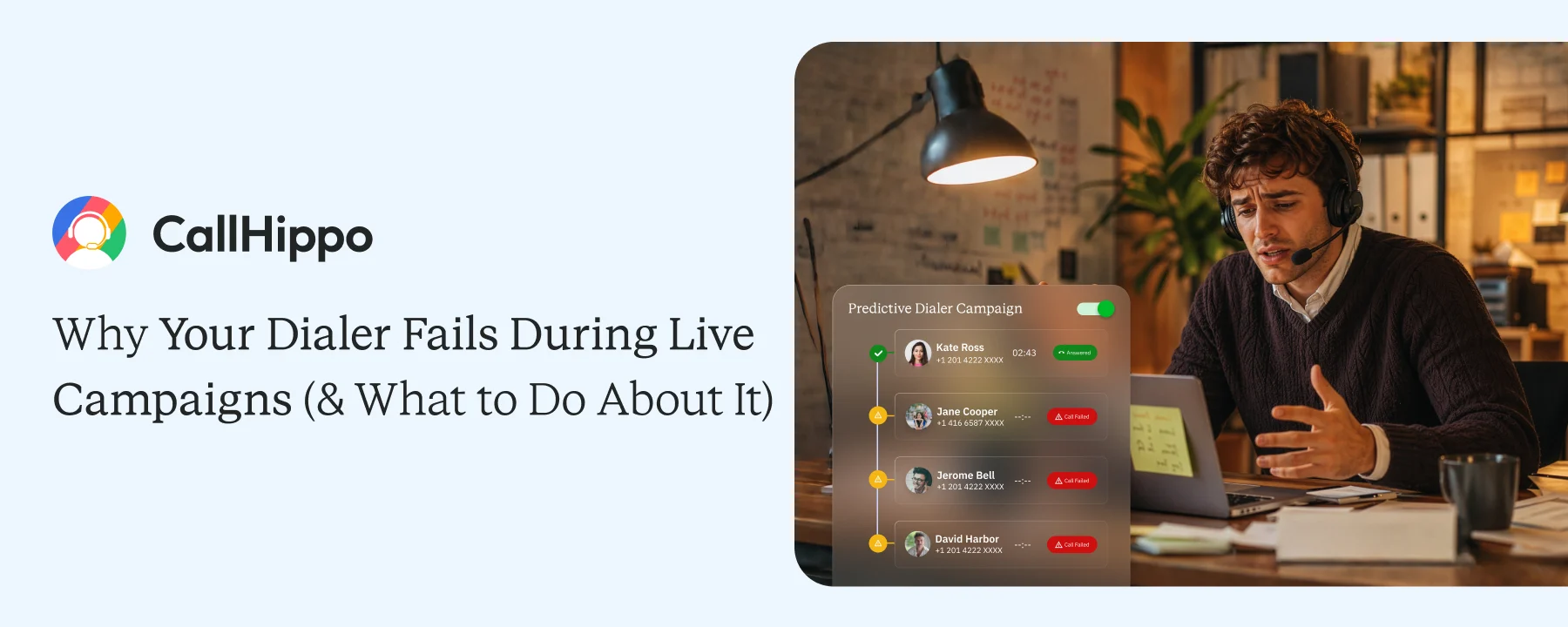
10:35 AM on a Tuesday. Your team is mid-campaign, hitting the highest-converting window of the week. Then the dialer freezes, and the calls drop. The reps try to refresh it, but nothing works.
Tickets pile up in the support portal. The chatbot suggests checking the help center. Your manager pings the vendor’s “live support” line and gets a queued response.
By 11:20 AM, the issue resolves itself. By then, 45 minutes of prime calling time is gone, and the chance to book meetings also vanishes. The chances that support teams will never get back again.
Why Dialers Fail Exactly When Campaigns Go Live?
This is not random. Three structural issues cause most live-campaign dialer failures, and they all surface at the worst possible moment.
1. Carrier Capacity Limits at Peak Hours
Every auto dialer routes calls through one or more telecom carriers. During peak calling hours, especially 10 AM to noon Eastern, those carriers hit capacity ceilings.
If your vendor only routes through one carrier, your dial volume queues up behind every other team on that same path. Your reps see stalled calls and dropped connections, but the real cause is that your traffic is waiting in line.
2. Multi-Dialer Thread Overload
When four or more agents on the same account run a power dialer simultaneously, the system has to manage hundreds of concurrent threads.
Cheaper dialers are not built for that load. Threads collide, the queue locks up, and reps see a spinning wheel where a call should be. The platform stays “online” while the function dies.
3. No Automatic Failover to a Backup Carrier
If a carrier route degrades mid-campaign, the dialer should automatically switch to a backup. Most do not.
They keep retrying the failing route until either the carrier recovers or your team gives up. Without automatic failover, you are not running a campaign anymore; you are just watching one die in real time.
 : Best Auto Dialer Software for your Business
What it Costs When the Dialer Goes Down Mid-Campaign?
The cost is never just the downtime. It compounds in three ways.
- Agent idle time: A 30-minute outage on a 30-rep team is 15 hours of paid agent time wasted, not counting motivation loss.
- Lost prospect windows: A prospect available at 10:30 AM on Tuesday is rarely available again until next Tuesday. The window does not reschedule.
- Pipeline gaps that do not recover: Missed first-touch attempts mean missed meetings, which means a quarter-end gap that no last-minute push can fully close.
A dialer with a high uptime guarantee is the difference between a campaign that delivers and a campaign that costs you a quarter.
CallHippo runs on multi-carrier redundancy with a 99.95% uptime guarantee, which means this scenario is designed out of the system, not managed around after it happens.
: Your Reps are Calling at the Wrong Time, and it is Burning Your LeadsWhy Your Support Ticket Won’t Save You When You’re Live?
When the dialer is down at 10:35 AM, you do not need a ticket queue. You need a human voice on the line in under five minutes.
Most dialer vendors are not built for that. Their support runs asynchronously: ticket portals, chatbots, and callback windows that conveniently fall outside US calling hours. Some keep their global support teams in time zones eight hours behind your campaign. By the time their day starts, your campaign is already over.
“Live failures need real-time response. Async support is not built for it.”
The structural mismatch is brutal. If your reps work US calling hours and your vendor’s live support starts in their morning, you are exposed every single day. The cost compounds quietly across every campaign you run.
What a Dialer Built for Campaign Reliability Actually Looks Like?
Reliability is not a feature; it is an architecture. The dialers that survive live campaigns share three traits.
1. Redundant Carrier Routing
Calls flow through multiple carriers, not one. If one route degrades, traffic shifts to the next. Your team never sees the failure because it gets corrected before they notice anything went wrong.
2. Automatic Failover
When a carrier hits capacity or call quality drops, the system reroutes within seconds. No manual ticket, no team awareness, no campaign disruption. The failover happens in the background while your reps keep dialing.
3. Live Support During Your Calling Window
If your campaign runs from 9 AM to 6 PM Eastern, your vendor’s live human support has to be live during that window, not after it.
CallHippo runs 24/7 live support across phone, chat, and email, with carrier-redundant routing and automatic failover built into the platform. Combined, those three things turn a 45-minute outage into a one-second hiccup nobody notices.
: Your Dialer Should Know When it is Illegal to CallWhat to Ask Your Dialer Vendor Before Your Next Campaign?
Before you commit budget to a campaign, get four answers in writing from your dialer provider.
- What is your uptime SLA, in writing? “Best effort” is not an SLA. Get a number, get the financial credit attached, and get it on paper.
- What are your live support hours versus my calling window? If their live human starts work eight hours after yours, you have no support during a live failure.
- How many carriers do you route through, and how does failover work? One carrier means one point of failure.
- When was your last failover test, and what happened? Vendors that have not tested in 12 months are gambling with your campaigns.
If your current vendor cannot answer any of these in five minutes, your next campaign is one carrier hiccup away from disaster.

Published : May 11, 2026

Satyaki is an SDR Lead at CallHippo with over three years of experience in B2B and B2C SaaS sales, specializing in lead generation, pipeline management, and international markets. Passionate about building meaningful connections, he brings a strategic yet people-first approach to driving business growth.

Subscribe to our newsletter & never miss our latest news and promotions.
 24k+ people have already subscribed