
 Updated : September 15, 2026
The conversation around AI voice agents keeps circling around one topic. How human does the AI voice agent sound?
But the real engineering challenge, making AI hear accurately in the environments where it will be actually used, is completely neglected.
And that’s exactly where most systems fail.
The best vendors are the ones who stopped optimizing for demo rooms and started engineering for call floors.
This is what the strongest implementations already understand.
This blog highlights what actually separates the systems that work from the ones that just sound good in demos.
AI Voice Demos are Tested in Quiet Rooms, Not Real Call Conditions
Demo environments are controlled. The microphone is close to the speaker, and the background is silent. The caller speaks clearly and deliberately. This is not how real calls happen.
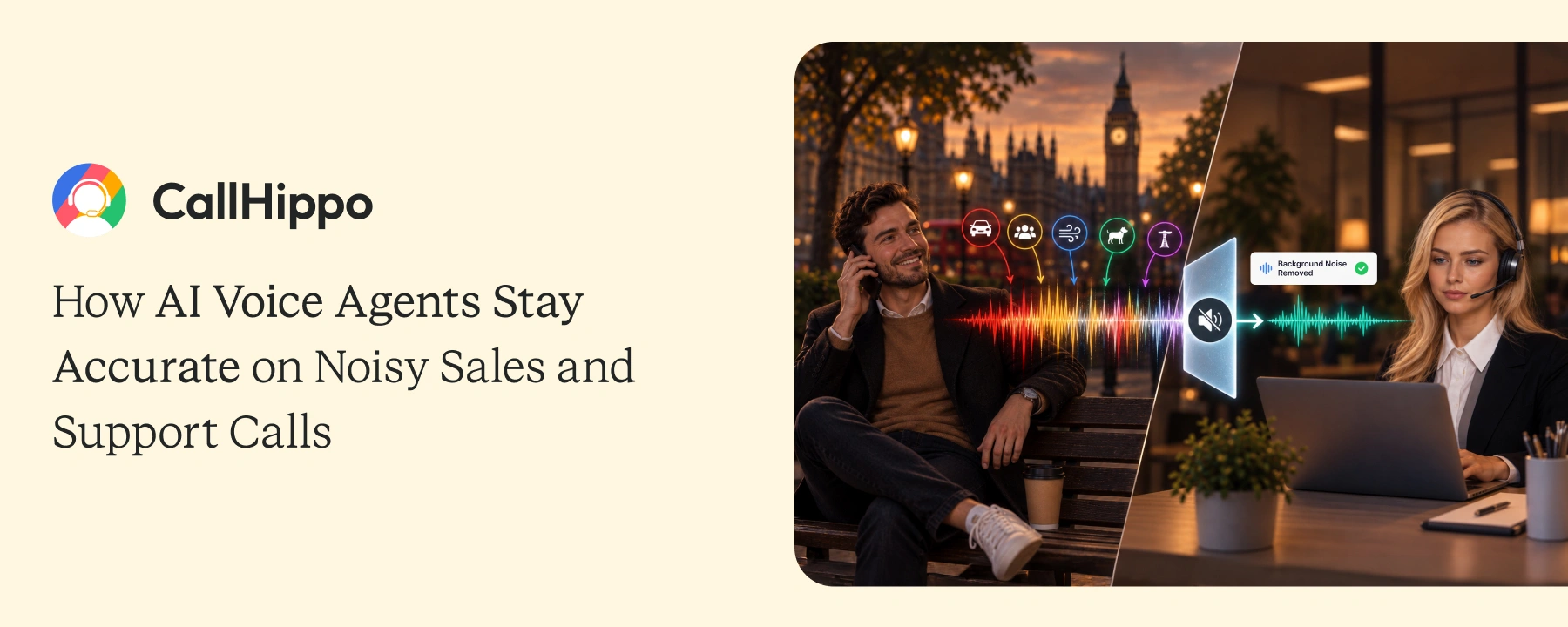
Real calls can come from moving cars, crowded coffee shops, homes with barking dogs, etc.
The caller speaks quickly. They can even mumble or interrupt. The audio quality can also vary by device, by network, by location.
Most AI voice systems are tested under perfect conditions, but are sometimes deployed in imperfect ones.
This is why most AI voice agents fail after they go live.
Where Does AI Voice Agent Accuracy Fail
Most evaluations of AI voice agents focus on conversation flow, tone, and how natural the responses sound.
None of that matters if the system mishears the input in the first place.
Vendors are being judged on quiet-room performance, not the audio conditions their agents will actually work in.
A system that understands every word in a soundproof booth might misunderstand half the words on a busy call center floor.
The failure point is not the language model, but the audio processing layer that sits between the caller and the model.
If that layer cannot filter noise, handle interruptions, and recover from unclear audio, the rest of the system does not matter.
 : 30 Examples of Empathy Statements For Customer Service That Work
A Single Misheard Word Can Break Trust in an AI Voice Agent Instantly
A wrong appointment time, a misread account number, or a support verification step that fails because the AI heard “fifteen” as “fifty.”
These are not small errors; they are deal-breakers.
When a human mishears something, the caller corrects them without a second thought. But when an AI mishears it, trust in the entire system breaks in that one moment.
The caller does not think, “The system had a bad audio moment.” They think, “This system is not reliable.”
A human agent acknowledges confusion and asks for clarification. An AI that mishears and proceeds confidently compounds the error.
What Separates a Good AI Voice Agent from the Bad Ones
The real difference between AI voice vendors is whether the system filters background noise, handles interruptions, and uses context to recover from misheard words.
CallHippo’s AI Voice Agent is built to handle real-world call conditions. The system prioritizes audio processing that works in noisy environments. It uses context to fill in unclear words. It recognizes when to ask for clarification rather than guessing.
The engineering focus is on making the system hear more accurately under the conditions in which it will actually be used.
: Your Dialer Should Know When it is Illegal to CallTest AI Voice Vendors With a Noisy Call, Not a Quiet Demo
Before buying, place a test call from a genuinely imperfect environment.
- Call from a moving car.
- Call from a crowded room.
- Call on speakerphone with background noise.
Ask the vendor directly what accuracy rate they guarantee outside a quiet room, not inside one. A vendor that cannot answer that question has not tested for it either.
Test the system in the environment where it will actually work.
How to Judge an AI Voice Agent?
The call center floor decides which AI vendors survive in the market.
If you ran your AI voice agent through a real, noisy call on your own floor today, are you certain it would still perform the same way?
Evaluate systems based on their performance in imperfect conditions, interruption handling, and ability to recover from unclear audio.
The vendors that survive will be the ones who stopped testing in quiet rooms and started engineering for real call conditions.
: AI Voice Agents Can Get You Fined If You Skip One Step: ConsentConclusion
AI voice accuracy is about the audio processing layer that feeds the model. The best systems are engineered to work efficiently in noisy environments as well.
The gap between demo performance and real-world performance determines which vendors actually deliver value and which just deliver good presentations.

Published : September 14, 2026

Ankit Dudhwewala is the CEO and Co-founder of CallHippo, a leading virtual phone system designed to optimize business communication through AI and automation. With a strong background in marketing and business administration, Ankit has successfully built and bootstrapped CallHippo. Ankit’s leadership and innovative approach have made him a prominent figure in the SaaS industry, driving growth and shaping the future of business communication solutions.

Subscribe to our newsletter & never miss our latest news and promotions.
 24k+ people have already subscribed