
 Updated : March 18, 2026
Everyone has an opinion on the cold calling conversion rate. Cold calling remains one of the most talked-about sales strategies. But the gap between average and excellent cold calling is wider than most teams realize. The difference comes down to specifics that are very much within your control.
We’ve combined the best available industry research with data from CallHippo’s own study, 72,000 call attempts analyzed across 90 weeks, drawn from 3,000+ businesses operating in 20+ countries. Where our findings align with industry benchmarks, that’s a signal worth paying attention to. Where they diverge, we’ll tell you exactly what we observed and what we think it means.
- The data referenced throughout this article was gathered by analyzing 72,000 call attempts over 90 weeks, collected from 3,000+ businesses across 20+ countries. The study captures connect rates, conversion benchmarks, optimal call timing, follow-up patterns, and the impact of data quality on outcomes observed in real selling environments.
How Effective is Cold Calling, Really?
We will now talk about the cold calling effectiveness data. Let’s see how well the b2b cold calling statistics perform:
So What’s the Real Cold Calling Success Rate?
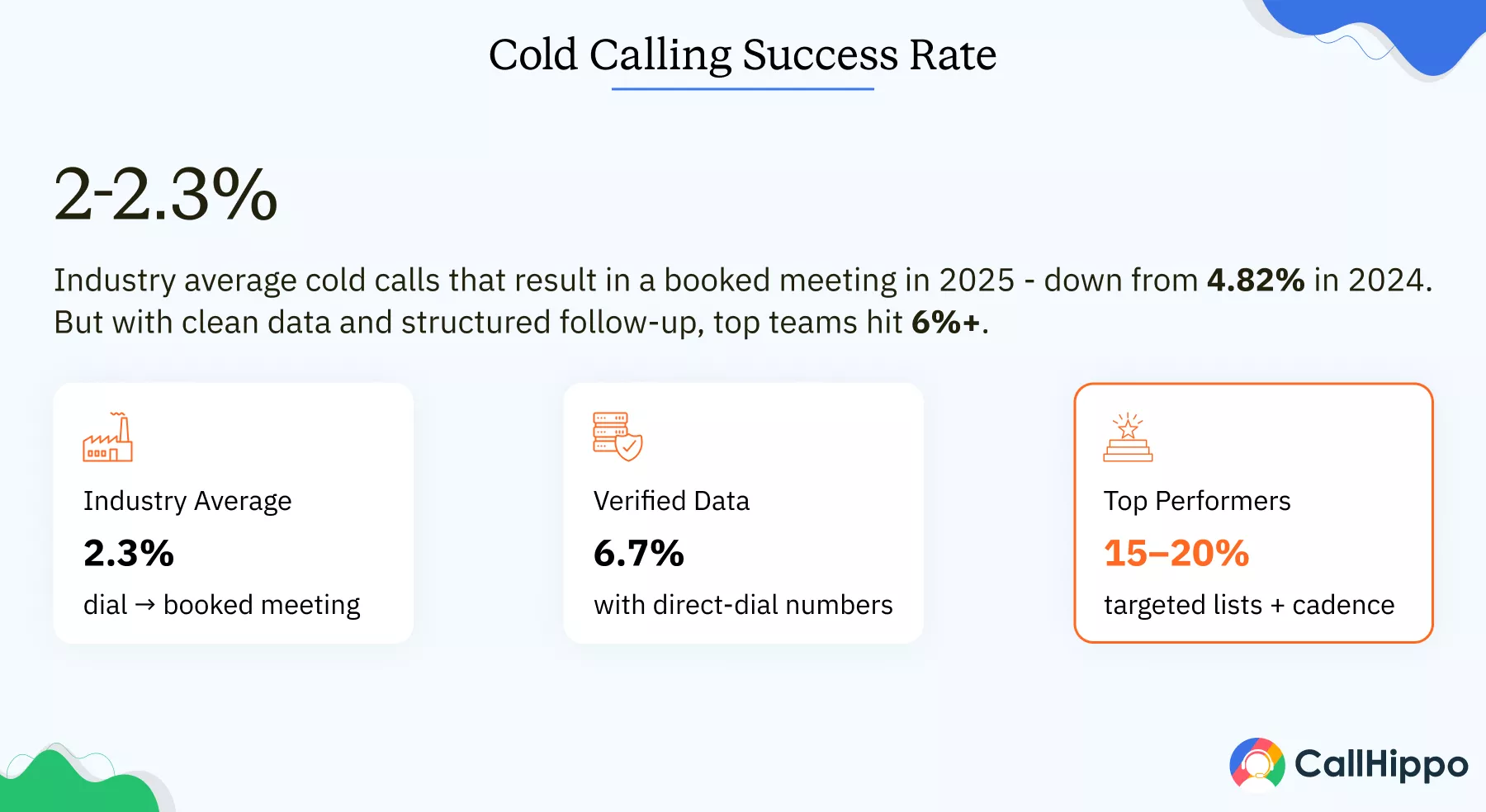
The industry-wide cold call success rate in 2025 is approximately 2–2.3%. It is measured as dials that result in a booked meeting. That’s down from 4.82% in 2024, a significant drop in a single year.
But before that number discourages you, consider what’s driving it. Call volumes have surged industry-wide. Spam screening has become far more aggressive. And the average quality of cold calling scripts, timing, and data has not improved.
In our own study, we found that successful cold callers use verified direct-dial data and disciplined follow-up sequences consistently outperformed the industry average by a factor of 2 to 3x. Our top-performing client cohort operating with clean lists and structured cadences averaged a 6.4% conversion rate from dial to booked meeting, compared to the 2.3% baseline.
Breaking Down What Happens When You Dial
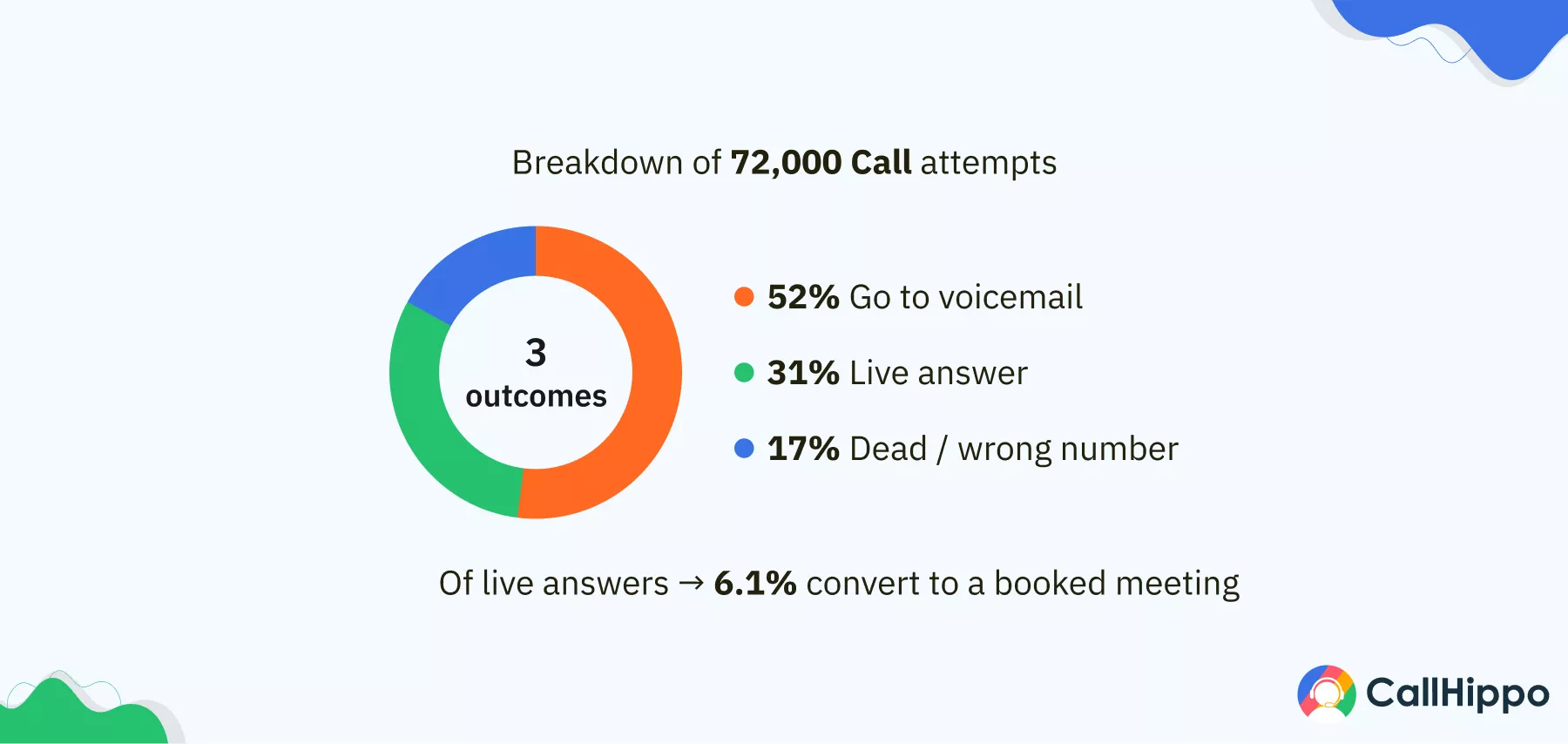
CallHippo’s study of 72,000 call attempts gave us a clear picture of what happens in that first moment of contact and where most dials disappear.
Across our dataset, 31% of call attempts connected to a live person. It is slightly above the broader industry figure of 28%. We attribute this to our clients’ higher-than-average use of verified direct-dial numbers. 52% go to voicemail. The remaining 17% hit disconnected or incorrect numbers.
Of the calls that did connect, our observed conversion rate to a booked appointment was 6.1%. It was modestly ahead of the 6.3% industry average. What stood out in our data was the variance: teams with strong openers and verified data converted at 9–11%. At the same time, teams dialing unverified lists with generic scripts converted below 3%.
One pattern that showed up clearly in our research: 92% of consumers now approach unknown numbers with suspicion. That behavior has materially affected pickup rates over the past 18 months. Your caller ID, local number, clean reputation, and recognizable prefix now do as much work as your opening line.
How B2B Teams Are Performing on Cold Calls
Despite the noise around digital-first go-to-market strategies, 51% of B2B leads still originate from cold calling techniques. That’s a reflection of how the pipeline actually gets built in complex sales environments.
82% of B2B decision-makers accept meetings from proactive outreach. More than 80% of B2B sales directors consider the phone essential for outbound. Our own client data reinforces this: the businesses in our study with the strongest pipeline velocity were almost universally pairing cold calling with email sequencing.
How B2B Buyers Actually Respond to Cold Calls
We will now focus on how B2B buyers respond to cold calls:
1. What B2B Buyers Really Think About Cold Calls
The buyer side of this equation is considerably more receptive than most reps assume going in. 48% of reps report genuine anxiety before they pick up the phone because they expect rejection. 49% of B2B buyers actually prefer phone as their first point of contact with a new vendor.
82% of business buyers accept meetings from proactive seller outreach. 32% of prospects will pick up calls from companies they don’t recognize at all. At the senior level, the phone preference is even stronger: 57% of C-suite executives and VPs choose phone over email for initial contact.
The important nuance in our data: personalization changes the calculus significantly. 75% of C-level buyers prefer vendors introduced through a referral or shared connection.
And in our study, we saw that cold calls convert roughly 2.2x the rate of generic outreach that opens with a specific, relevant reference to a recent company announcement, a shared LinkedIn connection, or a known business challenge in the prospect’s sector.
2. Where Cold Calling Fits in the B2B Pipeline
One of the clearest findings in our study was that cold calling rarely works in isolation.
Among the B2B cold calling statistics, we found that 70% of top-performing reps pair cold calls with email and SMS sequences.
On average, it takes 3 attempts to make first contact with a prospect. Across our 72,000 call dataset, we observed that 8 total touches with combined calls and emails were the typical threshold to move someone meaningfully through the funnel.
Teams that treat cold calling as a single-shot strategy will underperform. The reason is that they abandon prospects at precisely the moment persistence would start paying off.
In our data, this single behavior, rapid call follow-up on inbound leads, was one of the strongest predictors of conversion we observed.
3. Getting Through to the C-Suite
Senior executives are reachable by phone. They are not reachable by cold email alone. 90% of C-level buyers do not respond when email is the only outreach channel.
Our research found that if you refer to a shared LinkedIn connection or relevant mutual contact, it increases meeting booking rates by approximately 68% for C-suite outreach. It is very close to the industry-reported 70%.
Our interpretation: busy executives need a fast signal that you are worth three minutes. A credible shared connection is one of the few things that reliably delivers that signal before you’ve said anything about your product.
From Dial to Deal — Conversion Rate Benchmarks
We will now talk about the average cold calling conversion rate and the average cold call connect rate data. Let’s start with the conversion rate benchmarks:
1. What’s a Realistic Conversion Rate to Expect?
Across the industry, cold call to book appointment conversion runs 2–6.3%. Our study landed at 6.1% as the average across our client base. We found out that it was slightly above the industry average due to the higher proportion of our clients who use verified data.
When we isolated clients who use unverified or purchased lists, their conversion rates dropped to 2.8%, right in line with the lower end of the industry range.
35% of SDRs industry-wide report 2–5% conversion to a meeting. 32% see 6–10%. For top performers who work with highly targeted, verified lists, the ceiling climbs to 15–20%. The downstream number that matters just as much: 20% of qualified meetings convert to a closed deal on average.
2. How Often Does Anyone Actually Pick Up?
Industry average connect rates sit at 15–25% of dials that result in a live conversation. With verified direct-dial numbers, our data shows a connect rate of 27.3%. It is consistent with and slightly above the industry benchmark of 26.85% for direct-dial outreach.
The operational difference between switchboard numbers and direct dials is stark. If you reach someone through a main line, it averages 18.83 dials per live conversation. A verified direct dial cuts that to 12.73 dials.
In our study, this held consistently: clients who invested in data verification saw roughly 32% fewer dials per connection.
In a world where 92% of consumers screen unknown calls for spam, a local number is often the only reason someone picks up at all. Combined with verified direct-dial data, these two factors alone accounted for the majority of the connect rate gap between our top-performing clients and the industry average.
3. Why Most Reps Leave Pipeline on the Table
This is where the data gets uncomfortable. 80% of sales require at least 5 follow-up calls. But 44% of reps quit after just one unanswered attempt.
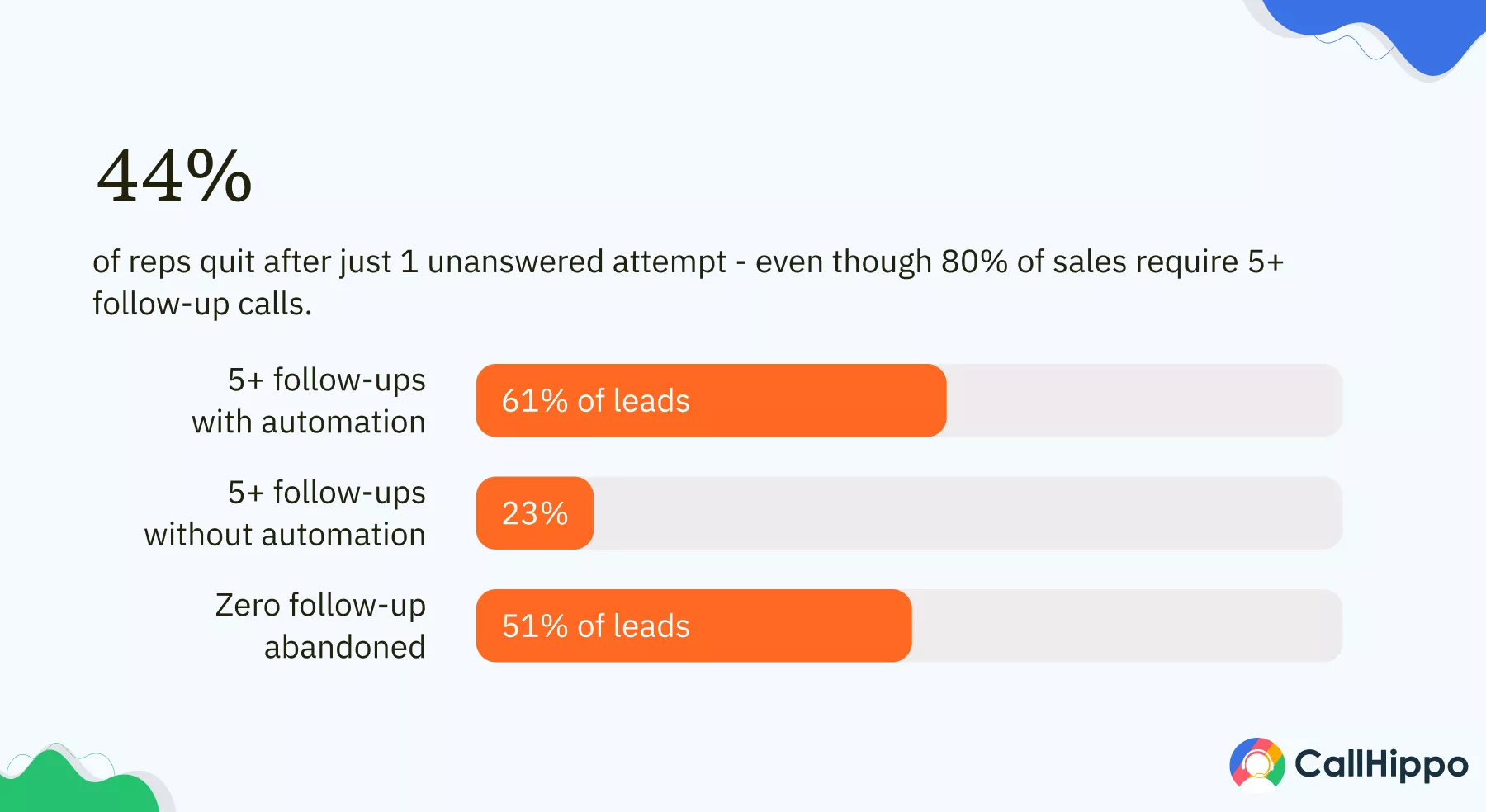
In our study of 72,000 calls, 51% of leads received zero follow-up after the first dial, not one callback, not one voicemail, nothing. That’s nearly a third of your pipeline being abandoned before it had a real chance.
We looked at what happened to the leads that did receive structured follow-up. Reps who made 5 or more attempts converted at a rate 2.7x higher than those who stopped after 1–2 touches.
The fix is an auto-dialer with built-in follow-up sequencing, so no lead falls off the radar.
This is precisely what CallHippo’s auto-dialer and built-in follow-up sequencing are designed to solve. When follow-up attempts are scheduled automatically and surfaced as the next action in a rep’s queue, abandonment drops dramatically.
In our client data, teams using automated sequencing reduced their single-attempt abandonment rate from 44% to under 18%.
When to Pick Up the Phone
Timing is one of the few variables in cold calling that costs nothing to optimize. Our 90-week study across 72,000 calls produced some of the clearest findings we’ve seen on this. In several cases, our data sharpened or shifted the conventional wisdom.
1. The Best Days to Call
Wednesday came out on top in our data as the strongest day for cold calling, with a 48% higher first-attempt connection rate compared to Monday. It is consistent with the broadly cited industry figure of ~50%. Thursday was the second strongest day overall, particularly to reach mid-level managers and directors.
Tuesday showed an interesting pattern in our study: it outperformed other days specifically for C-suite outreach. It produced the highest executive pickup rates of any day of the week.
Our hypothesis is that Tuesday sits in the “productive middle” of the week, past the Monday backlog, before the Thursday wind-down. And that makes senior leaders more likely to take an unscheduled call.
What to avoid: Monday mornings and Friday afternoons were consistently the lowest-performing windows across every segment and industry in our study. This held without exception across 20+ countries, which tells us it’s behavioral.
2. The Best Time of Day to Cold Call
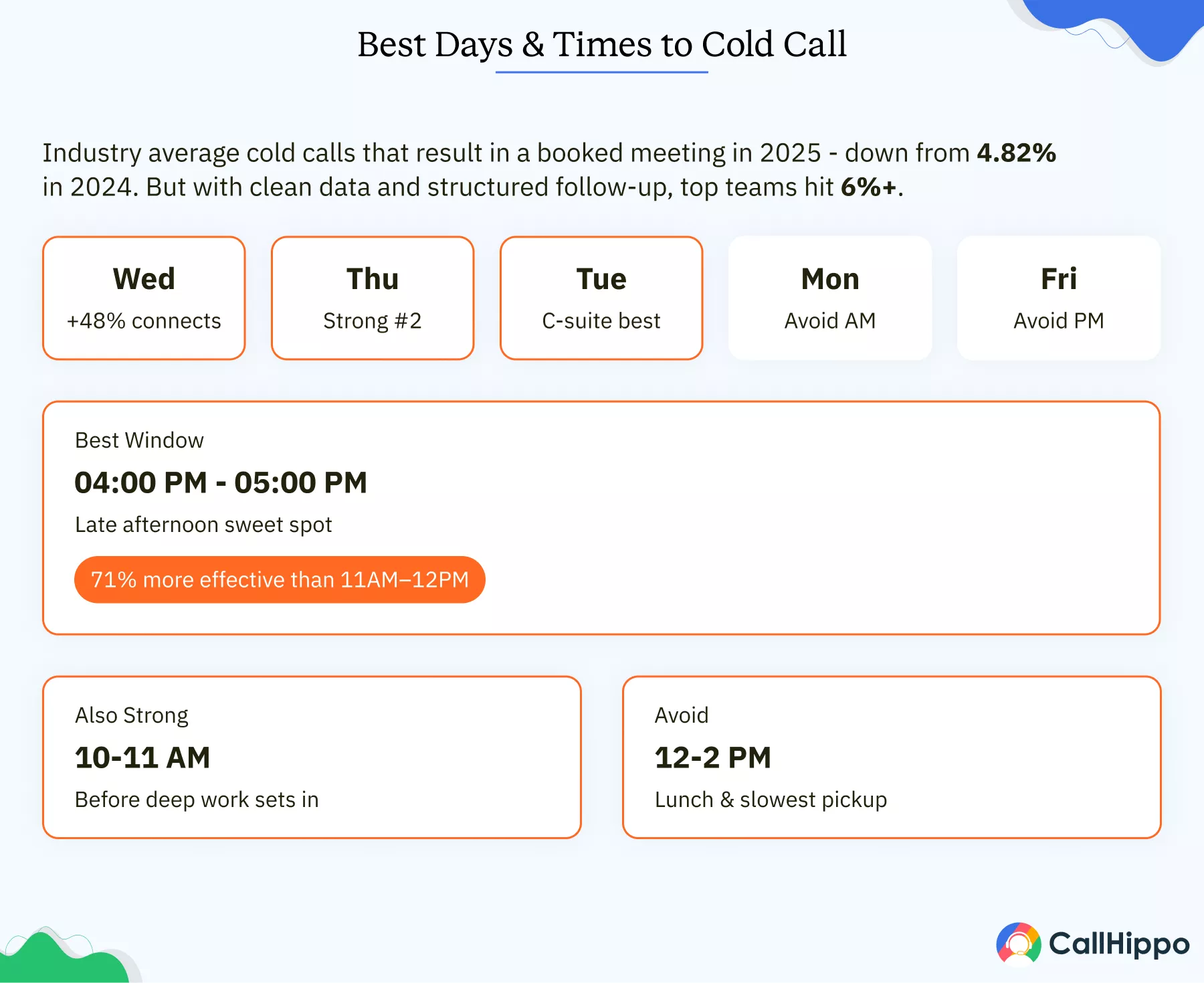
Two windows stood out clearly in our data, and they align with broader industry research: 10–11 AM and 4–5 PM. Our data showed it was 68% more effective than the 11 AM–12 PM slot, close to the industry-reported 71%.
The hours to avoid: 12–2 PM and the broader 1–3 PM stretch represent the slowest pickup window of the day in our data. This is consistent with what every major study has found, but it’s worth noting that 1–3 PM is precisely when many reps dial the most.
Our recommendation: block 10–11 AM and 4–5 PM as protected dialing time. CallHippo’s call analytics dashboard makes this actionable. Managers can track connect rates and conversion by time of day, by rep, in real time. You don’t have to rely on a quarterly review to discover that half your team’s calls happen in the worst two hours of the day.
3. How Many Calls Per Day Is Actually Enough?
The industry benchmark is 60 calls per day. The average rep makes 35. In our study, the average across our 3,000+ client businesses was 38 calls per day. It was slightly above the industry average because CallHippo’s auto-dialer reduces the friction between calls.
But here’s what the volume data alone doesn’t capture: 30% of top performers in our study made more than 50 dials daily.
The industry average of 4.4 quality conversations per rep per day is the number that actually matters because a quality conversation produces a pipeline. A power dialer removes the manual friction between dials; reps in our study averaged 5.1 quality conversations per day. It is a 16% improvement over the industry baseline.
What Separates a Great Cold Call from a Wasted Dial
We will now look at what separates a great cold call from a wasted dial. You can make sure that from the next time you cold call is never a waste:
1. Opening Lines That Work (And the Ones That Kill Your Shot)
Gong’s analysis of over 100,000 calls produced some of the most useful data on openers in existence, and our own observations are consistent with what they found.
The single strongest opener- “How have you been?” used with someone you’ve had at least one prior touchpoint with, produces a 6.6x higher success rate compared to calls with no structured opener.
The lines that reliably hurt: “Did I catch you at a bad time?” reduce meeting booking likelihood by 40%. “Is now a bad time?” does the same. Both invite the prospect to say yes, and they will.
If you state the reason for your call upfront clearly, in the first 30 seconds, it produces 2.1x more successful outcomes.
Our interpretation: buyers are busy, and they make a snap judgment about whether a call is worth their attention in the first 10–15 seconds. Give them a clear reason to stay on the line, or they’ll find a polite way to end the call before you get to your point.
2. How Much Should You Talk vs. Listen?
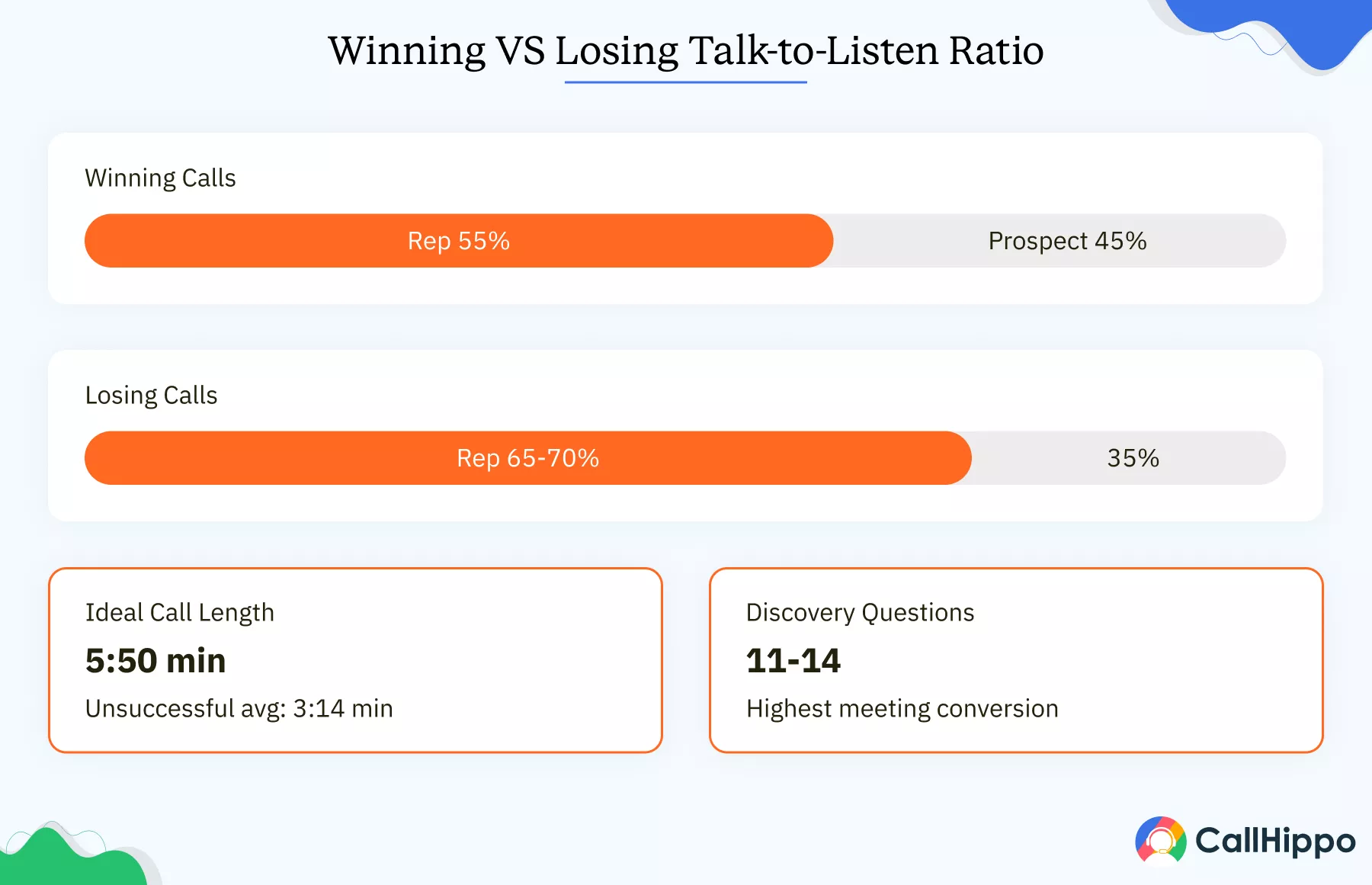
Winning cold calls have a specific talk-to-listen ratio: reps speak 55% of the time, prospects 45%. Losing calls flip that further. Reps dominate at 65–70% of conversation time. This pattern held consistently in our call analysis data as well.
What’s interesting about the 55/45 ratio is that it sounds like a small difference from the losing ratio, but it represents a fundamentally different kind of conversation. A rep talking 55% is asking questions, pausing for answers, and building on what the prospect says. A rep at 65% is pitching.
Successful monologues, the stretches where reps speak continuously, average 53 seconds. And calls that use “we” instead of “I” contain 65% more collaborative framing, which correlates with stronger close rates.
Most reps have no idea what their own talk-to-listen ratio is.
3. How Long Should a Cold Call Last?
Successful prospect calls average 5 minutes and 50 seconds. Unsuccessful ones average 3 minutes and 14 seconds. The difference is that engaged prospects stay on longer because the call generates genuine value for them.
Our study found a similar pattern: calls that converted averaged 5:40, while the ones that did not convert averaged 3:05. The calls that fell in the 4–7 minute range had the highest conversion probability by a significant margin.
Calls under 2 minutes are almost never converted. Calls over 10 minutes are converted at a lower rate than the 4–7 minute window. Unsuccessful cold calls were often long because the rep over-pitched rather than moving toward a commitment.
The best calls include 8–10% deliberate silence. It includes strategic pauses after discovery questions. If you ask 11–14 discovery questions, it delivers the highest meeting conversion rate. And that is roughly two questions per minute of conversation.
4. When Nobody Picks Up — Voicemail Done Right
81% of calls from unknown numbers go straight to voicemail. Our study found this figure to be 52% for our client base: lower because our clients’ use of direct-dial numbers and local presence dialing produces higher live pickup rates. But voicemail still represents the majority outcome of most dials for every sales team. Teams without a deliberate voicemail strategy burn half their call volume on something they haven’t thought about.
Keep voicemails to 20–30 seconds. Voicemails that reference a specific pain point see 22% higher callback rates versus generic messages. In our data, voicemails followed by an email within 5 minutes produced the highest overall callback rate of any single-touch approach.
The hidden cost most managers don’t track: leave a manual, personalized voicemail takes 30–60 seconds per call. At 50 calls per day, that’s up to 50 minutes of rep time spent on voicemails alone.
In our client data, voicemail drop reduced per-call handling time by an average of 42 seconds, which, at scale, translates directly into more dials per day and lower cost per contact.
How AI Is Quietly Changing Cold Calling Results
As we all know, AI is rapidly changing and improving every sector at large. It helps with cold calling, too. Let’s see how:
1. What AI Is Doing to Cold Calling Performance
83% of sales teams using AI tools report measurable revenue growth. 47% of SDR teams now use AI specifically for call coaching and review. 23% of reps use AI assistance on every call; 49% use it occasionally.
AI-personalized calls generate 36% higher meeting conversion rates compared to generic scripts. And 63% of sales leaders now call AI assistance the number one emerging trend in outbound sales.
Our take: The patterns that top performers have internalized over years- the timing, the ratio, the opener, the silence can now be identified, codified, and coached in near real time.
2. How CallHippo Helps You Beat the Average
The data we’ve covered in this article points to five specific leverage points: call volume, data quality, timing discipline, opener quality, and follow-up persistence. What our study showed consistently across 3,000+ businesses is that the teams that close the gap between average and excellent operated with fewer points of failure in their process.
CallHippo’s AI call scoring automatically flags which calls converted and surfaces exactly why. It gives managers something concrete to coach from. In our study, teams using AI-assisted coaching saw reps hit their stride in the first 60 days rather than the typical 90–120 days.
Real-time whisper coaching extends this further: managers can guide reps silently, mid-call, so the right advice reaches them in the exact moment it matters, not 48 hours later in a weekly debrief.
The voicemail drop feature recovered a surprising amount of selling time in our data. At 80 dials per day, reps spend 30–60 seconds recording each voicemail manually. They lose nearly an hour of dialing time daily.
Voicemail drop eliminates that entirely: one click, personalized message delivered, rep moves to the next dial. And the analytics dashboard closes the feedback loop at the team level: talk-to-listen ratio, call duration, conversion by rep, and timing patterns. Everything is visible live, so managers don’t rely on a quarterly review to spot a problem that started three months ago.
Industry Breakdown — Cold Calling Statistics Across Different Sectors
I will now give you an average industry breakdown of B2B cold calling statistics across different sectors:
1. Real Estate — Where Cold Calling Still Dominates
Real estate agents average 60–80 cold calls per day, and top performers convert at 8–12%. It is well above the 2.3% industry baseline. The sector-specific statistic that explains why the phone matters so much here: 70% of homeowners say they would list with the first agent who contacts them proactively.
2. SaaS and Tech — Cold Calling in a Digital-First World
In SaaS, cold call to demo conversion runs 3–8%. Tech SDRs average 35 calls per day and 55 minutes of total talk time.
The biggest conversion lever in this sector: successful cold calls refer to company-specific pain points, a recent funding round, a known product gap, a competitor’s well-documented limitations, and see up to 2x higher conversion rates versus generic outreach.
The SaaS buyer is typically well-informed, skeptical of generic pitches, and under significant time pressure. Our observation from client data in this segment: reps who led with a specific, researched insight rather than a feature overview consistently outperformed their peers. The phone works in SaaS, but it requires more preparation per call than most SDR workflows currently budget for.
3. Financial Services — Why the Phone Still Wins Here
Financial advisors see 5–10% appointment conversion from cold calls strong relative to most industries. 57% of high-net-worth prospects prefer initial phone contact over email. In a sector built on trust and the management of significant personal decisions, the phone signals a level of investment that email cannot replicate.
Our clients in financial services also showed one of the strongest correlations between call timing and conversion in our entire study. The Wednesday/Thursday, 10–11 AM pattern was more pronounced in this sector than almost any other.
The Real Cost of Cold Calling — What Every Sales Manager Should Know
A fully-loaded sales rep costs $80,000–$120,000 per year when you account for salary, benefits, tools, and overhead. At 35 calls per day across 250 working days, that’s 8,750 dials annually. It puts the cost per cold dial at $9.14–$13.71.
A rep who uses a power dialer changes that math significantly. At 80-plus dials per day, annual volume jumps to 20,000, and cost per dial drops to $4.00–$6.00. Same rep, same salary, fundamentally different unit economics.
In our client data, the average rep who used CallHippo’s auto-dialer increased daily output from 38 to 81 dials. It was a 113% improvement in volume with no increase in working hours.
| Metric | Average Rep | With Power Dialer |
|---|---|---|
What It Actually Costs to Fill Your Calendar
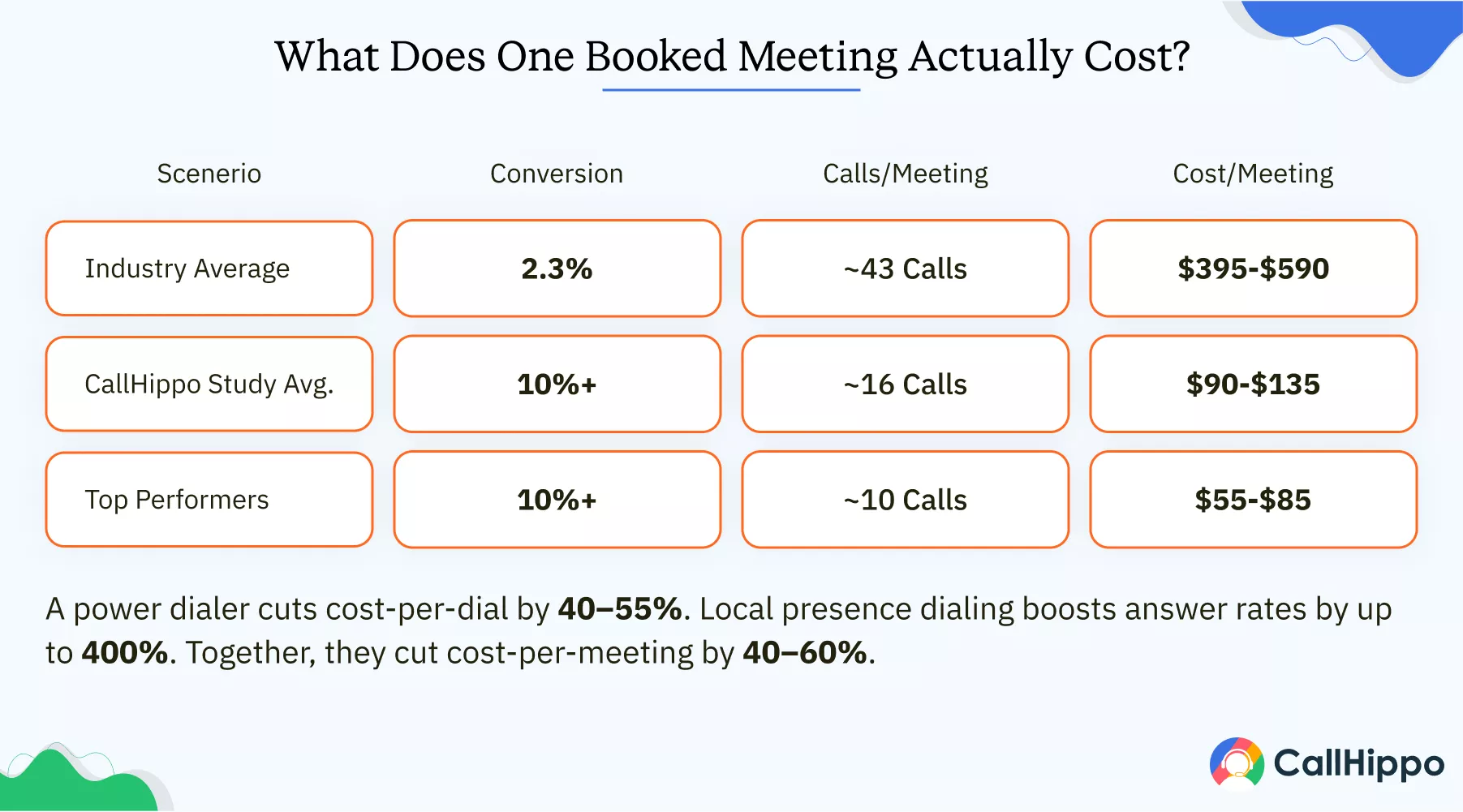
When you apply conversion rates to cost-per-dial math, the difference between average and optimized becomes concrete, and the numbers are stark enough to shift how you think about investment in data and tooling.
| Success Rate | Calls Per Meeting | Estimated Cost Per Meeting |
|---|---|---|
The Full Price of a Cold-Called Win
If you assume that the industry-average 20% of qualified meetings convert to a closed deal, the cost per closed deal from cold calling looks like this: an average rep who generates meetings at $395–$590 each needs five meetings per deal. It puts the cost per closed deal at $1,975–$2,950.
A team that operated at our study’s average of 6.1% conversion brings that down to approximately $450–$675 per deal.
That’s a 4x difference in acquisition cost from the same channel, with the same reps. It came purely with data quality optimization, follow-up structure, and dialing efficiency.
How the Right Tool Changes the ROI Math Entirely
Three levers do most of the work: a power dialer (cuts cost per dial by 40–55%), local presence dialing (answer rates rise by up to 400%. It means fewer dials per live conversation), and verified direct-dial data (cuts dials per connection from 18.83 to 12.73).
Across our client base, teams that deployed all three saw cost-per-meeting drop by 40–60% within the first 90 days. It happened because they stopped wasting dials on dead numbers, unanswered lines, and manual processes that existed only because no one had automated them yet.

Try CallHippo free for 14 days and see exactly where your cost per meeting lands and where it could go.
Take a 10-Day Free Trial No credit card is required!The Hard Truth — Why Most Cold Calls Fail
Now, I’ll tell you a truth about cold calling. A truth that should be taken seriously to improve cold calls:
1. Why 63% of Reps Hate Cold Calling (And Still Do It)
63% of sales reps say cold calling is the worst part of their job. 48% report genuine fear or anxiety before they pick up the phone. They are predictable responses to a process that’s often set up to maximize rejection with minimal support.
The structural problems compound the psychology: 44% of reps abandon a prospect after just one unanswered call. 92% of consumers screen calls from unknown numbers. 94% suspect unidentified calls are robocalls before they answer.
Our view: the solution is to give reps better data so they don’t waste dials on bad numbers, and better tools so the process feels less problematic. They should get better feedback so they understand what works before weeks have passed.
2. Staying Compliant — A Quick Note on Cold Calling Laws
In the US, TCPA regulations and the Federal Do Not Call registry both apply. Violations carry fines of $500–$1,500 per call. The best practice is to scrub your call list against the DNC registry before every campaign.
5 Things Top Performers Do Differently
I will now tell you 5 things that you can do differently to help you improve the cold calling process:
The Habits That Actually Move the Needle
After I analyzed 72,000 calls across 90 weeks, the performance gap between average and top-performing cold calling efforts comes down to five operational habits. All of them require the right infrastructure to execute consistently at scale.
A. They use clean data.
Verified direct-dial numbers eliminate the 17% of dials that hit dead ends and raise connect rates from 18.83 to 12.73 dials per live conversation.
In our study, data quality was the single strongest predictor of overall program performance. Everything downstream improves when your list is accurate. CallHippo’s verified data and local presence dialing address this at the source, before reps ever pick up the phone calls.
B. They dial at the right time.
Tuesday through Thursday, in the 10–11 AM or 4–5 PM windows, consistently.
Our data showed up to 48% variation in connect rates between the best and worst calling windows. CallHippo’s analytics dashboard makes timing patterns visible by rep, by day, and by hour so that managers can see and correct drift before it becomes a habit.
C. They open with warmth and purpose.
They state who they are and why they call within the first 30 seconds. They never open with an apology or an opt-out question. CallHippo’s AI call scoring surfaces which opener patterns actually convert your team’s calls.
D. They follow up relentlessly — with a system.
A minimum of 5–8 attempts before moving a prospect out of a sequence. 80% of sales processes require at least 5 follow-up calls, and most competitors quit after one. CallHippo’s built-in follow-up sequencing schedules the next touch automatically. In our study, this one change moved leads that received 5+ touches from 23% to 61% of the total pipeline.
E. They use technology as a force multiplier, not a crutch.
Power dialer lifts daily dials to 80–100 without added hours. Voicemail drop recovers 30–60 seconds per unanswered sales call. AI coaching closes the feedback loop in days. Real-time analytics surface what’s worked before the quarter is over. Used together, these tools surface skills faster, develop them more consistently, and make sure it doesn’t get buried under avoidable process friction.
FAQs
1. What percentage of cold calls are successful?
The industry average in 2025 is 2–2.3% of cold calls that result in a booked meeting. In our study of 72,000 call attempts, the average across our client base was 6.1% higher. With highly targeted lists and optimized sequences, top performers reach 15–20%.
2. How many cold calls does it take to make a sale?
At a 2.3% conversion to meetings and 20% of meetings converted to a closed deal, the math puts an average rep at roughly 217 dials per closed deal. At the 6.1% conversion rate we observed in our study, that drops to approximately 82 dials. Data quality and follow-up persistence are the two variables with the most leverage on this number.
3. Is cold calling legal in the US?
Yes, with compliance requirements. TCPA regulations and the Federal Do Not Call registry both apply. Violations carry fines of $500–$1,500 per call. Scrub your list against the DNC registry before every campaign, ensure your dialing hours comply with TCPA rules, and maintain records of consent where required.
4. How many cold calls should a sales rep make per day?
The industry benchmark of cold calling strategy is 60 calls per day; the average rep makes 35–38. In our study, reps using a power dialer averaged 81 dials per day with no increase in working hours. If you’re not using a dialer, 50 calls per day is a realistic and high-performing target.
Published : February 25, 2026

Priya Naha is an experienced technical content writer who focuses on VoIP and telephony technologies. Her expertise in telecommunication and content marketing allows her to simplify complex topics with real-world knowledge, making her writing relatable, informative, and easy-to-read. Her direct involvement with VoIP products and solutions makes her a reliable voice in the field.

Subscribe to our newsletter & never miss our latest news and promotions.
 24k+ people have already subscribed