
 Updated : October 12, 2026
Marketing can tell you what a lead cost down to the cent. Ask what it cost to turn that lead into a qualified sales conversation, and the answer is usually a guess.
I believe this is one of the most overlooked gaps in how companies measure growth.
Calls are where marketing spend becomes revenue, yet it has the least financial visibility of any stage in the funnel.
In this article, I will show you how to calculate the real cost of a lead from calls, and why every calling and AI budget decision should start with that number.
A Call Costs More Than Its Minutes
Picture a quarterly review. Marketing presents its cost per lead, accurate to the cent. Every click is tracked, and every campaign is attributed.
Then one question comes up: what did it cost to turn those leads into qualified sales conversations? The room goes quiet, because nobody has that number.
This is the gap most organizations face. Until a lead picks up the phone or gets called, spend is visible and attributed. After that, it disappears. The most expensive part of the funnel is the one nobody measures.
 : What Does “Qualified Lead” Actually Mean in an Outcome-Based AI Pricing Deal?
Call Costs Are Spread Across Three Budgets
Part of the problem is structural.
- Telephony charges sit with finance.
- Rep time sits in payroll.
- Dialers, CRMs, and AI tools sit in software spend.
Each owner sees one slice, so nobody sees the total.
No single report adds them up, which is why the cost of calling stays hidden even when every line item is accounted for.
Cost per lead from calls is the total cost of telephony, rep time, and calling tools in a period, divided by the number of qualified conversations those calls produced.
It measures what it costs to turn a phone interaction into a sales-ready conversation, not just what it costs to generate the lead.
Here is a simple example for one month.
(Note: The numbers are illustrative, and “loaded” rep time means salary plus benefits and overhead.)
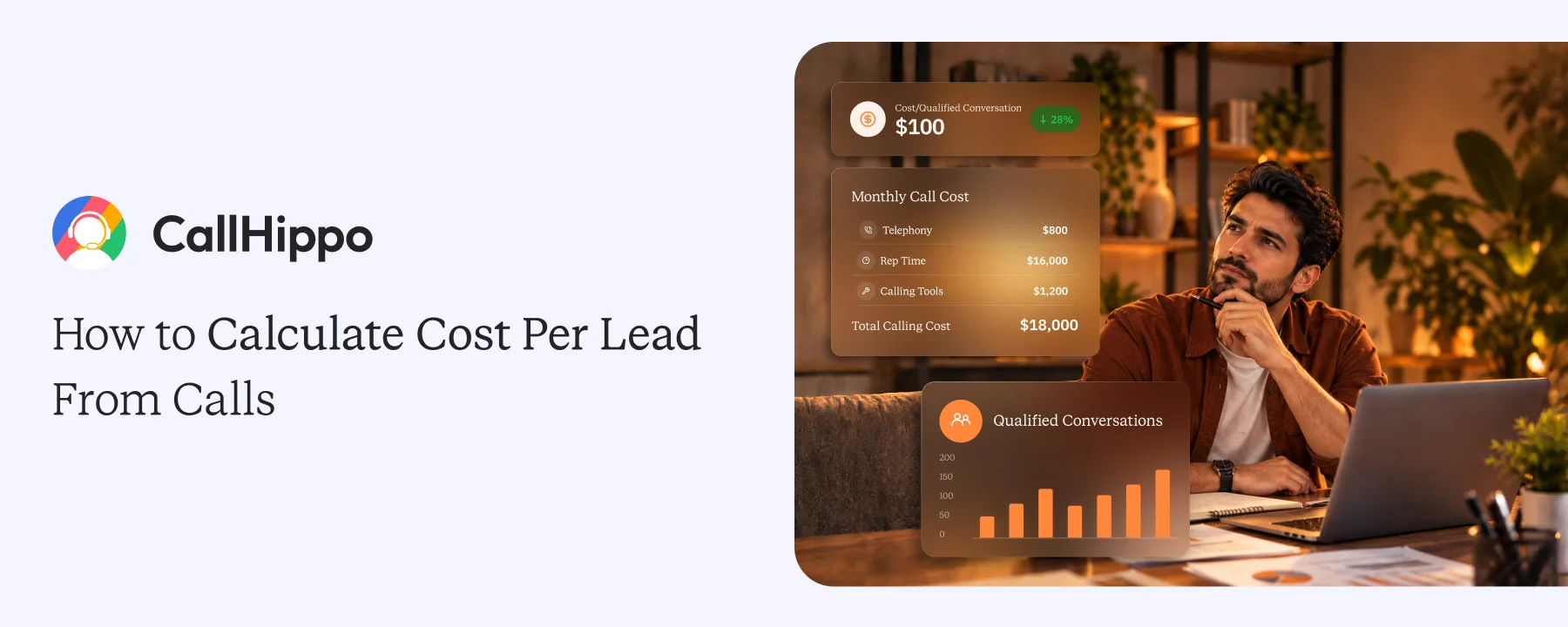
- Telephony charges: $800
- Loaded rep time: 4 reps × 100 hours on calls × $40 = $16,000
- Calling tools (dialer, CRM, AI): $1,200
- Total calling cost: $28,000
- Qualified conversations produced: 180
- Cost per qualified conversation: $18,000 ÷ 180 = $100
That $100 sits on top of whatever marketing paid to generate the lead. It is the number the quarterly review was missing.
: Outcome-Based AI Pricing Means You Only Pay When the AI Actually WorksWithout This Number, Tool Budgets Are Guesswork
Leaders now compare a per-seat dialer with a per-minute AI voice agent, and many choose on sticker price.
Without a baseline cost per qualified conversation, they cannot tell whether either tool lowers it. That makes it easy to cut the wrong cost, or to pay for the wrong one.
The baseline is also inflated by waste (unanswered dials, voicemails, no-shows, etc.) that never appears on a single invoice.
Reps spending their best hours on unqualified calls. Each one is paid for in telephony charges and rep time, and none is labeled as waste.
Until you measure the cost per qualified conversation, you pay for all of it without seeing it.
Measure the Cost of a Qualified Conversation, Not a Call
Stop measuring cost per call or cost per minute. Both reward activity.
A team can dial more, talk longer, and lower its cost per minute while producing fewer sales-ready conversations.
Cost per qualified conversation is the only number that connects calling spend to pipeline.
Once you have it, every tooling decision becomes simple arithmetic.
Does this tool lower the cost per qualified conversation, and by how much? If it does, it earns its budget. If it does not, no demo or discount changes that.
Outcome-Based Pricing Tells You the Cost Upfront
Per-seat and per-minute pricing makes you do the math after the fact, if you do it at all.
CallHippo’s outcome-based pricing for AI voice agents flips this. It charges per qualified lead or booked meeting.
Here is a simple example. Say CallHippo’s outcome-based AI agent charges $40 per booked meeting, and you booked 100 meetings. You pay $4,000. If the agent books only 60, you pay $2,400.
Underperformance shows up as fewer meetings, not as a bigger bill.
Find Your Number Before the Next Budget Meeting
Go back to that quarterly review. The next time marketing quotes a cost per lead, you should be able to ask for the second half of the number and get an answer.
So here is my challenge. Could your team produce its cost per qualified conversation within a week? If not, every AI and calling-tool budget approved this year was signed without knowing what it was supposed to beat.
: Outcome-Based Pricing for AI Voice Agents: A Smarter Pricing ModelConclusion
Cost per lead tells you what it costs to start a conversation. Cost per qualified conversation tells you what it costs to make that conversation count.
Add up telephony, rep time, and tool spend, divide by qualified conversations, and you have a baseline for every decision that follows. Whether you buy seats, minutes, or outcomes, that number tells you if the price is right.

Published : October 12, 2026

Ankit Dudhwewala is the CEO and Co-founder of CallHippo, a leading virtual phone system designed to optimize business communication through AI and automation. With a strong background in marketing and business administration, Ankit has successfully built and bootstrapped CallHippo. Ankit’s leadership and innovative approach have made him a prominent figure in the SaaS industry, driving growth and shaping the future of business communication solutions.

Subscribe to our newsletter & never miss our latest news and promotions.
 24k+ people have already subscribed