
 Updated : August 24, 2026
Outcome-based AI agents are winning over sales leaders fast.
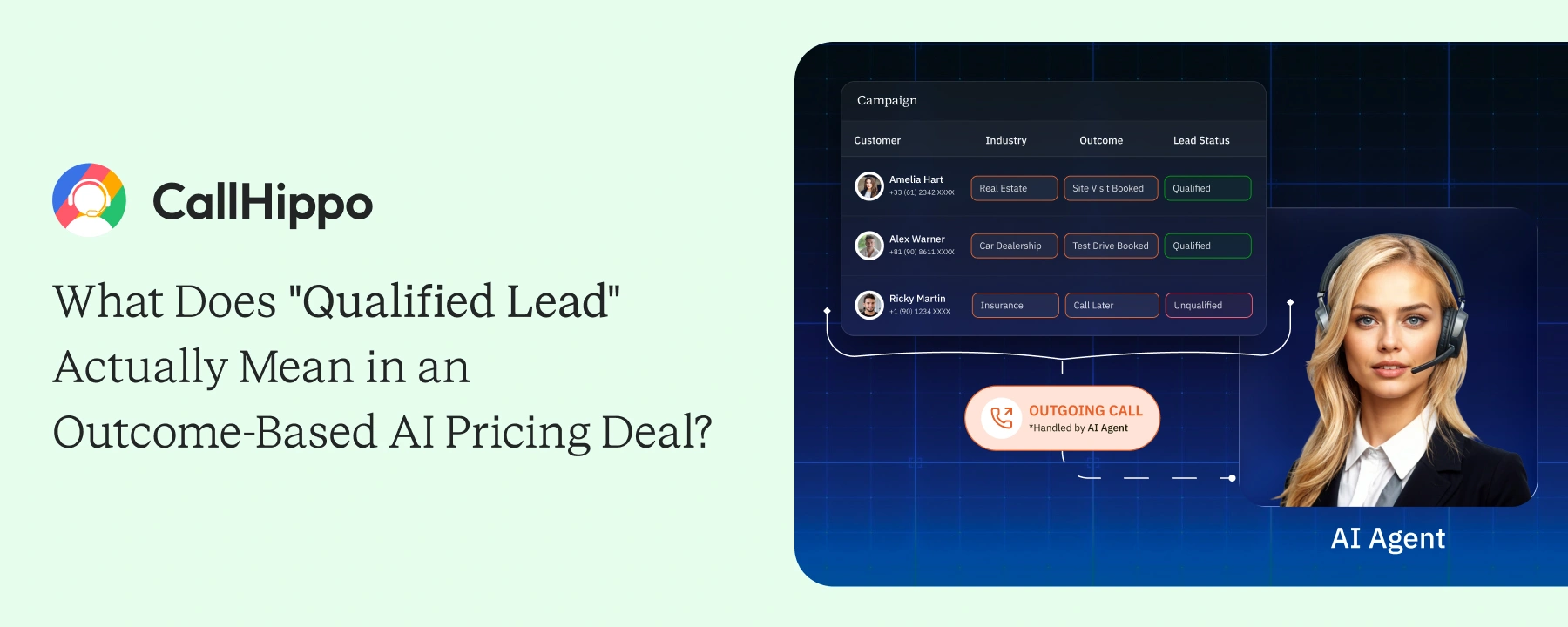
The pitch is simple, and it is a good one. You only get charged when the AI offers a result, usually a “qualified lead.”
There is just one thing most people never pin down. What does “qualified” actually mean?
Get that answer right, and this pricing works in your favor. Let me show you exactly how to define it.
Two Companies Can Pay the Same $5 Per Lead and Get Completely Different Results
Picture two companies signing the same deal. Both pay $5 per qualified lead. Both get a stack of leads each week.
- Company A’s AI marks a lead as “qualified” the moment someone stays on the line past thirty seconds.
- Company B’s AI marks a lead as “qualified” only if the person asked about pricing or booked a slot.
Same price. Wildly different value.
Company A is paying $5 for a pulse. Company B is paying the same amount for real intent.
The invoices look identical. The results are not even close.
What Counts as a “Qualified Lead” Is Rarely Defined in Outcome-Based AI Contracts
“Qualified lead” sounds precise. But in practice, it is one of the vaguest terms in sales.
Ask 10 leaders what it means, and you will get 10 different answers. Yet almost every outcome-based AI deal gets negotiated on the price line.
And that is the wrong place to focus.
The price is fixed and easy to compare. But the definition is where the real value sits.
It quietly decides what you are actually paying for. So it deserves far more attention than the price.
An Unclear Definition of “Qualified” Wastes Sales Time, Not Just Money
Here is the part that is most frustrating.
Set the bar too low, and the AI will clear it all day long. Your bill stays reasonable, and the dashboard looks busy.
- But your sales team’s calendar fills with people who were never going to buy.
- Your best reps spend their best hours on dead conversations.
The wasted resource was never the money. It was your team’s time. And that time is exactly what the AI was supposed to protect.
 : Calling From the Same Number Every Time is Getting You Flagged
Define “Qualified Lead” as Written Criteria, Not a Vendor Default
So here is the reframe. “Qualified” should never be a vendor’s hidden default. It should be “written criteria” you sign off on before a single call goes out.
Put it in the contract and make it specific enough to audit.
There is an even simpler way to avoid the confusion, too.
Tie your payment to an outcome that defines itself. That is the idea behind outcome-based AI agents like CallHippo’s, which charge only when a demo is actually booked.
A booked meeting is not a matter of opinion. It sits on a calendar, or it does not. When the outcome is that concrete, “qualified” stops being a debate.
: You Use Specialized Tools for Email, LinkedIn, and CRM. Why Not for Calling?Write a Clear Definition of “Qualified Lead” Before Signing an Outcome-Based AI Contract
Here is a simple test before you sign anything. Try to write down what “qualified” means in one clear sentence.
Then show that sentence to two people on your team to make sure they clearly understand the meaning. Next, give them the same ten calls to review.
- If they both mark the same calls as qualified, your definition is clear.
- If they pick different calls, your definition is too vague.
And if you cannot write the sentence at all, do not sign yet. You do not really know what you are paying for.
The Real Cost of an Outcome-Based AI Deal Depends on How “Qualified” Is Defined
Now go back to those two companies. Same $5, same invoice, but one built a pipeline of real buyers, and the other bought a list of people who simply did not hang up.
The price told you nothing about which deal was smart. The definition told you everything.
So the real question was never “how much does an outcome cost?” It was always “what did we agree an outcome actually is.”
: Why Your Brand Disappears the Moment You Call a ProspectConclusion
Outcome-based pricing can be a genuinely good deal. But only when both sides agree on the outcome in plain writing. Nail the definition before you ever discuss the price. Because in these contracts, the definition is the price. Get it right, and the AI protects your team.

Published : August 20, 2026

Ankit Dudhwewala is the CEO and Co-founder of CallHippo, a leading virtual phone system designed to optimize business communication through AI and automation. With a strong background in marketing and business administration, Ankit has successfully built and bootstrapped CallHippo. Ankit’s leadership and innovative approach have made him a prominent figure in the SaaS industry, driving growth and shaping the future of business communication solutions.

Subscribe to our newsletter & never miss our latest news and promotions.
 24k+ people have already subscribed