

 Updated : November 18, 2026
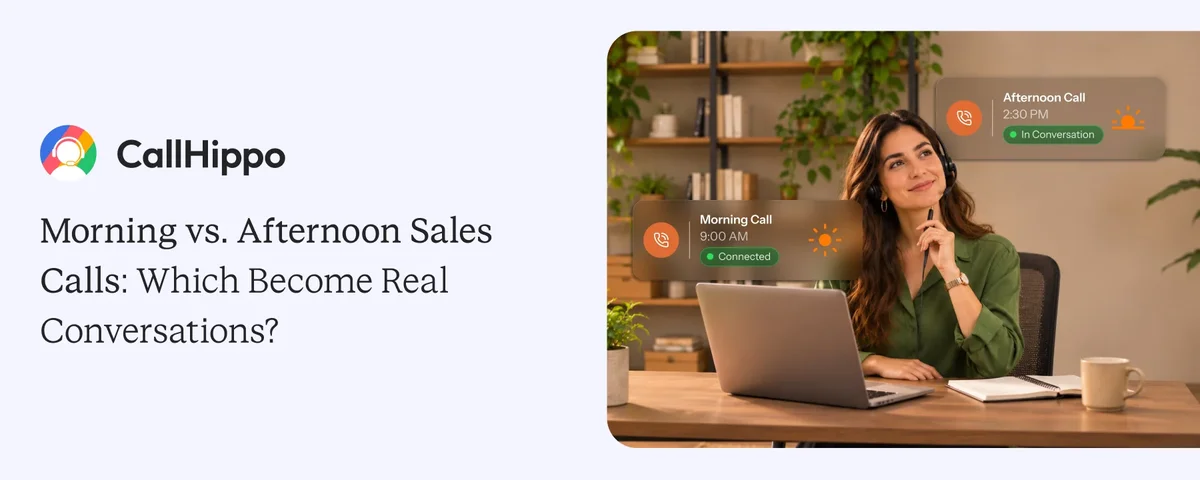
Picture two connect-rate dashboards side by side.
One is your morning calling block. The other is your afternoon.
The numbers are almost identical, so most sales leaders would call it a tie and move on.
I think that would be a mistake.
The figures here come from anonymized, aggregated outbound US calls on the CallHippo platform, taken from a recent weekly analysis.
I’ll show you why the morning still wins, and why it isn’t the reason you think.
On a Connect-Rate Dashboard, the Afternoon Looks Just as Good
In a US call sample from a recent weekly analysis, the human connect rate was 58.0% for calls placed between 7 and 10 a.m. Eastern. For calls placed between 2 and 5 p.m. Eastern, it was 58.4%.
That gap is within normal sampling variation. In plain terms, pickups were flat.
If your team plans its day around connect rate, this looks like proof that timing does not matter.
That is where the dashboard stops telling the full story.
How Is Connect Rate Different From Conversation Rate?
Conversation rate is the share of dials that become a call lasting a set length, such as 30 or 60 seconds. Connect rate only counts that someone answered.
Two time blocks can share a connect rate and still differ widely in conversations.
A pickup that ends after a few seconds counts the same as a long discovery call. The same trap shows up when voicemail pickups make call duration a misleading SDR metric.
Morning Calls Reached a One-Minute Conversation Almost Twice as Often
When we compared morning vs. afternoon sales calls by conversation rate, the tie disappeared.
In a recent weekly analysis of US calls, calls placed between 7 and 10 a.m. Eastern reached a 60-second conversation 15.0% of the time, against 8.5% for calls placed between 2 and 5 p.m.
The pattern held at shorter lengths too:
- 30-second conversation rate: 25.8% in the morning vs 20.0% in the afternoon.
- Answered calls lasting 30 seconds or more: 44.5% vs 34.2%.
- Answered calls ending in under 10 seconds: 27.5% vs 35.5%.
More than a third of answered afternoon calls ended within 10 seconds. A call that short is rarely a real conversation.
The Question Isn’t When People Answer, but When They Have Time to Talk
Most advice on the best time to call ranks hours by pickup rates or survey answers. That answers the wrong question.
The better question is when your buyers have time to talk. Answering a phone takes a second. Staying on for a minute takes attention.
One possible explanation is that people have fewer meetings early in the day, so your call does not compete with the next calendar invite. Our data does not prove this. It is worth testing with your own buyers.
This is also why call volume is not a productivity metric. Dials and pickups measure activity. Conversations measure the chance of progress.
Who Is Calling at 7 a.m. May Matter as Much as When
Before you rebuild your calendar, read the fine print.
- The account mix changes by block. A different set of businesses calls in the morning than in the afternoon. Part of the gap may reflect who calls when, not just the hour.
- Everything is in Eastern time. All US numbers are bucketed in ET, so 7 a.m. Eastern is 4 a.m. Pacific.
- Compare blocks, not single hours. This sample comes from a one-week window. Single-hour figures can swing by about 4 percentage points either way, so 3-hour blocks are the fair comparison.
- This is our customer mix, not every caller. The figures reflect businesses on our platform, not a random sample.
- “Longer” means share, not average. I am talking about the share of calls that reach 30 or 60 seconds, not average call duration.
Listening to the Calls Tells You What the Clock Can’t
Numbers tell you that morning calls more often turn into conversations. They do not tell you why.
For that, you need to hear the calls. Pull a handful of answered calls from each block and compare them. How fast does the prospect say they are busy?
Searchable call transcripts come standard with phone systems such as CallHippo, so a manager can read a morning call next to an afternoon one.
Transcripts will not change your connect or conversation rates. They show you what is happening inside them.
What Would Your Call Blocks Look Like Ranked by 60-Second Conversations?
Rank your calling blocks by 60-second conversations per dial, not by pickups. Most phone systems with call analytics can show call outcomes and durations by hour.
Then compare that list with your ranking by pickups. If they match, your schedule is fine. If they don’t, your best reps may be on the phone during the hours that produce the fewest real conversations.
Use what you find to shape your outbound calling strategy. Give your strongest callers the blocks that produce conversations.
 : Outbound Call Strategy: The B2B Playbook That Fills Pipeline in 2026
Conclusion
In our data, pickups were flat, but conversations were not. Morning calls reached a one-minute conversation almost twice as often. Judge your calling blocks by conversations, not pickups. Then test it on your own list, because your buyers decide when they have time to talk.
Published : November 18, 2026

Ankit Dudhwewala is the CEO and Co-founder of CallHippo, a leading virtual phone system designed to optimize business communication through AI and automation. With a strong background in marketing and business administration, Ankit has successfully built and bootstrapped CallHippo. Ankit’s leadership and innovative approach have made him a prominent figure in the SaaS industry, driving growth and shaping the future of business communication solutions.

Subscribe to our newsletter & never miss our latest news and promotions.
 24k+ people have already subscribed