
 Updated : June 23, 2026
Most sales calls are lost not on the call itself, but in the decision to make it without context.
The difference between a call that lands and one that gets hung up on rarely comes down to the script. It comes down to preparation: who you are calling, what they already know about you, and how ready they are to have the conversation. That is the essence of lead temperature, and it separates cold calling, warm calling, and hot calling into three fundamentally different sales disciplines.
This guide breaks down each approach to help sales teams match the right strategy to the right prospect, every time.
What is a Cold Call?
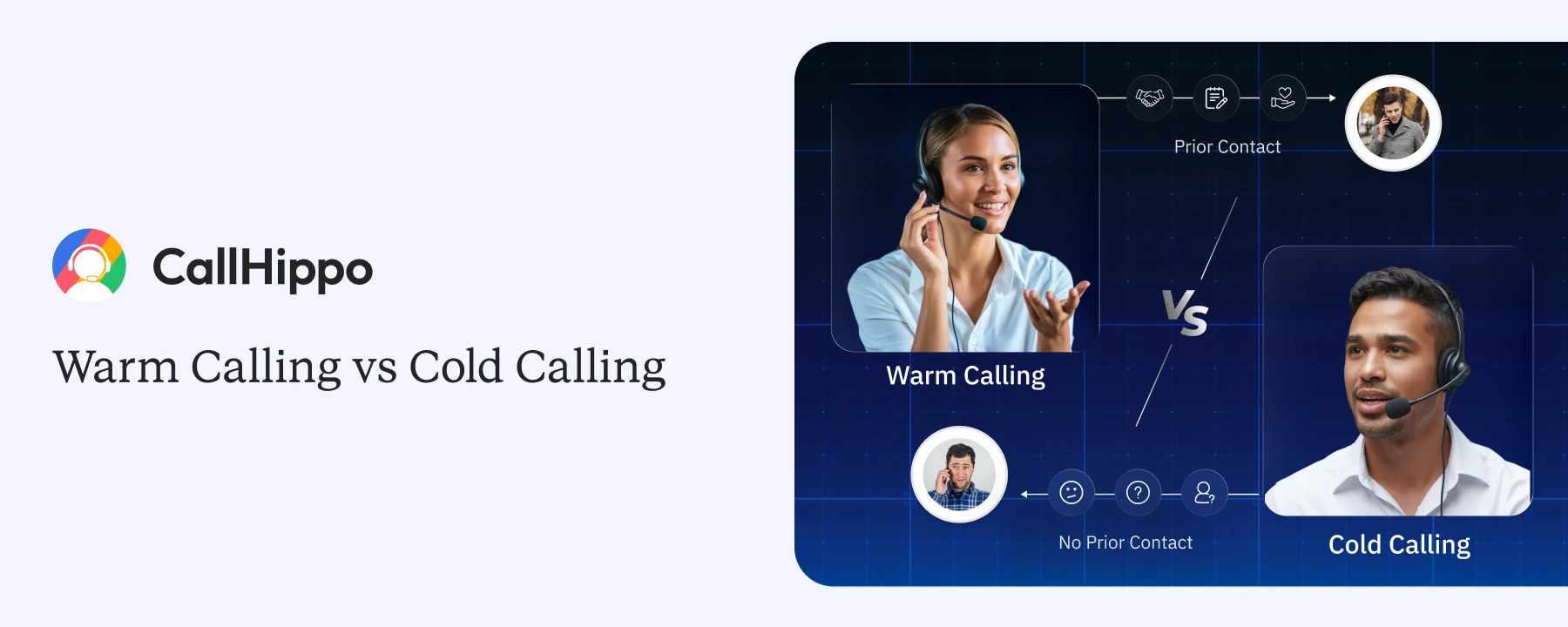
A cold call is an outbound sales call made to a prospect who has had zero prior interaction with your brand. The person on the other end does not know your company, has not requested information, and is almost certainly not expecting your call.
Cold calling means working from a prospecting list built through market research, intent data providers, or firmographic filtering. Cold calling carries real compliance risks. In most jurisdictions, outbound callers must respect Do Not Call (DNC) lists, and regulations like TCPA in the US impose strict consent requirements on automated dialing. Any team running cold call campaigns needs to ensure their technology stack includes built-in DNC compliance checks.

CallHippo's Power Dialer keeps your reps in back-to-back conversations: no idle time, no missed opportunities.
What is a Hot Call?
A hot call is a sales call made to a prospect who has demonstrated strong, active buying intent. This is someone who filled out a demo request form, clicked “Contact Sales,” responded to a direct outreach with a specific question about pricing, or triggered a high-intent action that signals they are actively evaluating solutions right now.
The defining characteristic of a hot call is timing and intent. The prospect is not just aware of your brand, they are in buying mode. Your job as the sales rep is not to create interest. It already exists. Your job is to clarify fit, confirm the solution, and move them toward a decision.
What is a Warm Call?
A warm call is placed to a prospect who has had some meaningful interaction with your brand but has not yet expressed direct buying intent.
Warm calling means you have already connected with the prospect before you dial. That connection could be in the form of a content download, a webinar attendance, a LinkedIn connection, or a referral from a mutual contact. The prospect knows your name or your brand, which means you do not have to spend the first minute of the call establishing basic credibility.
Warm Calling vs Cold Calling vs Hot Calling: A Side-by-Side Comparison
Here is how cold calling, warm calling, and hot calling differ across every factor that matters in a sales conversation.
| Factor | Warm Call | Cold Call | Hot Call |
|---|---|---|---|
Notice that cold calling demands the most resilience but returns the least per call. It is a volume game by design. That is why cold calling without a power dialer or parallel dialer is an uphill battle: manual dialing burns time that should be spent talking.
Second, hot calling demands the least volume but the most preparation. A rep who shows up to a hot call without knowing the prospect’s pain points, company context, and prior interactions has wasted the single highest-conversion opportunity in the funnel. Hot leads do not reward laziness.
Third, warm calling is where the skill of personalization pays off most directly. The prospect has context, but no urgency. The rep’s job is to create that urgency by connecting the prospect’s prior engagement to a specific, timely reason to move forward.
Advantages and Disadvantages of Each Approach
Cold Calling Pros and Cons
Pros:
- Gives you access to the largest possible addressable market, anyone who fits your ICP
- Enables immediate outreach without waiting for inbound signals
- Tests your messaging and value proposition at scale faster than any other channel
- Builds resilience and objection-handling skills in reps over time
Cons:
- Rejection rates of cold calls are high, and most prospects will not pick up or will hang up quickly. HubSpot’s sales statistics confirm the average cold call success rate sits at 2–3% in 2025.
- Time-intensive for relatively low return, especially without the right dialing technology
- Compliance risks around DNC lists, TCPA, and similar frameworks add operational overhead
Warm Calling Pros and Cons
Pros:
- Significantly higher conversion rates than cold calling.
- Shorter, more focused conversations because the prospect already has context
- Builds on the investment your marketing team made to generate the lead
- Lower stress on reps, which tends to improve call quality and consistency
Cons:
- Requires a functioning marketing engine to consistently generate warm leads—no inbound content strategy means no warm leads
- Smaller total lead pool than cold calling, since you are constrained to people who have already engaged
- Timing dependency: a prospect who downloaded a report six months ago is much colder than one who watched a webinar last Tuesday
Hot Calling: Pros and Cons
Pros:
- Highest conversion rates of all three types when handled well
- Shortest sales cycle: hot leads have already done much of their own research
- Prospect is emotionally receptive, making calls lower-stress and more collaborative
- Allows reps to focus on fit and solutions rather than building awareness from scratch
Cons:
- Smallest lead pool: hot leads are scarce relative to warm or cold leads
- Heavily dependent on strong inbound marketing and lead scoring infrastructure
- Risk of overconfidence: reps who assume a hot call is already closed can skip preparation and lose deals they should have won.
The Lead Temperature Scorecard: Classify Any Prospect in 60 Seconds
Most sales teams classify leads as simply “contacted” or “not contacted.” The teams that consistently outperform their peers classify leads by temperature before they dial, and they do it fast.
Use this scorecard to assign a temperature to any prospect in under a minute. Give the prospect 1 point for each of the following:
How to Make Warm and Hot Calls More Effective
Here is how you can make warm and hot calls more effective:
For Warm Calls
- Lead with the thread. The single most important thing a warm call rep can do is open with a specific reference to the interaction that created the warmth. It signals that you did your homework and that this is not a mass-dialed cold call.
- Do not re-introduce your company from scratch. They already know you. Summarizing your company’s full background to a warm lead wastes their time and signals that you are treating them like a cold prospect.
- Ask about the problem, not the product. Instead of “Let me walk you through our features,” try “What was going on when you decided to download that guide? What problem were you trying to solve?” Warm leads respond to consultative questions.
For Hot Calls
- Prepare a tailored agenda. Hot leads expect you to be ready. Know their company, their pain points (they have probably already stated them in the form they submitted), and come with a clear plan for the call.
- Bring solutions, not features. Hot leads need to know how your solution solves their specific problem. Use their submitted form responses, prior email threads, or CRM notes to anchor every point in their stated context.
- Always commit to a next step with a timeline. Before the call ends, give them something concrete: “I can have a proposal to you by Thursday,” or “Let me block time for a technical walkthrough next Tuesday at 2 PM.” Hot leads make decisions quickly and give them something to decide on.
- Listen more than you talk. This sounds obvious, but hot leads will literally tell you what they need to close if you give them space to speak. The reps who close the most hot calls are the best listeners.
Sales Tools That Support Each Call Type
Choosing the right tool for each call type is as important as choosing the right cold calling script. Here is how modern sales technology maps to cold, warm, and hot calling:
1. CRM Systems
Before a rep dials any number, they should be able to see every interaction that the prospect has had with your company. Without CRM data, you cannot tell whether a lead is cold, warm, or hot. You are guessing.
2. Auto-dialers and Power Dialers
A power dialer automatically connects the next call as soon as the previous one ends, eliminating idle time and dramatically increasing daily connect rates.
CallHippo’s Power Dialer does exactly this, keeping reps in back-to-back conversations, and its Automatic Machine Detection feature ensures reps are only connected to live humans, not voicemail systems.
For teams that need even higher volume, CallHippo’s AI-powered Parallel Dialer dials multiple numbers simultaneously and connects reps only when a live person answers.
3. Prospecting and Data Tools
Data and prospecting tools help reps research prospects before cold calls and identify warm or hot intent signals from third-party data. When integrated with a platform like CallHippo, these signals flow directly into the dialer queue, so reps always know the situation of the next call before they pick it up.
4. Sales Engagement Platforms
These tools orchestrate multi-channel sequences like email, LinkedIn, call, and SMS that progressively warm up cold leads before any phone call is made.
5. Conversation Intelligence
These tools analyze call recordings to identify what actually works in warm and hot calls, which openers lead to longer conversations, which objections get resolved most effectively, which reps have the highest conversion rates, and why.
CallHippo’s AI Copilot does this automatically, generating post-call summaries, sentiment analysis, and keyword tracking that help managers coach reps based on real call data.
Building a Balanced Sales Calling Strategy
Top-performing sales teams use all three call types intentionally, as part of a connected system:
- Cold calls fill the top of the funnel. They expand your addressable market, identify ICP-fit accounts that have never heard of you, and create the raw material that your nurture sequences will eventually warm up.
- Warm calls nurture the middle. They follow up on marketing engagement, keep prospects moving through the funnel, and build the relationships that eventually produce hot opportunities. Warm calling is where consultative selling skills matter most. Every conversation should move the prospect’s temperature one degree higher.
- Hot calls close the bottom. They are the highest-leverage activity in the sales motion. Every team should have a protocol for routing hot inbound leads to the right rep within minutes of a form submission.
Marketing and sales alignment is not optional in this model. Marketing must share lead engagement data with sales in real time. Sales must feed back conversion data to marketing so content can be optimized for the signals that actually predict purchase intent.
Conclusion
Warm calling, cold calling, and hot calling are three stages of the same sales system. Cold calls build awareness. Warm calls build trust. Hot calls close deals.
The teams that win are the ones who stop treating all leads the same and start matching their approach to where each prospect actually is. With the right lead scoring system, the right tools, and the right call strategy for each temperature, every dial becomes a more intentional and more productive investment of your reps’ time.
If you are ready to build a smarter outbound calling engine, CallHippo’s AI-powered dialing platform gives your team everything it needs to move faster on cold leads, engage better on warm ones, and close hot opportunities before they go cold.

From cold prospecting to hot deal-closing, CallHippo gives your sales team one platform to do it all.
Take a 10-Day Free Trial No credit card required!FAQs
1. How do you turn a cold call into a warm call?
The best way to convert cold leads into warm ones is through multi-channel pre-call engagement. Before dialing, send a personalized LinkedIn connection request, a relevant email with a piece of content tied to their industry challenge, or a targeted ad through account-based marketing. When you call after one or two of these touchpoints, the prospect has seen your brand, and the call is no longer cold. Sales engagement platforms that orchestrate these sequences automatically are the most scalable way to do this at volume.
2. Should sales reps prioritize hot calls over cold calls?
Yes, but not exclusively. Hot calls have the highest return on time invested, so reps should always respond to high-intent signals first. However, a team that only takes hot calls will eventually run dry because hot leads require a pipeline of cold and warm leads to generate. A well-structured calling day dedicates time to hot follow-up first, warm nurturing second, and cold prospecting last, but does not neglect any of the three.
3. How many calls does it take to close a deal?
Hot leads typically close in 1–2 calls. Warm leads usually require 3–5 touches across calls, emails, and follow-ups. Cold leads require 8–12 or more contacts before a deal progresses. This is why lead scoring and temperature classification matter so much: when reps know the temperature before they dial, they set realistic expectations for the number of touches required and do not abandon leads too early.
Published : April 2, 2026
Shubham Nikam, Senior Product Marketing Specialist, brings 5 years of experience in VoIP demand generation and lead generation. He specializes in B2B SaaS, focusing on cloud telephony and CCaaS. Shubham excels in developing go-to-market strategies, optimizing product messaging, and leveraging AI tools to drive growth and customer acquisition.

Subscribe to our newsletter & never miss our latest news and promotions.
 24k+ people have already subscribed