
 Updated : June 23, 2026
Your reps are hitting their dial targets. The activity numbers look fine. But somewhere in the last quarter, connect rates quietly slipped and the forecast started feeling softer than it should.
If you haven’t investigated your caller ID reputation, that’s where I’d start looking.
The Problem Nobody on Your Team Can See
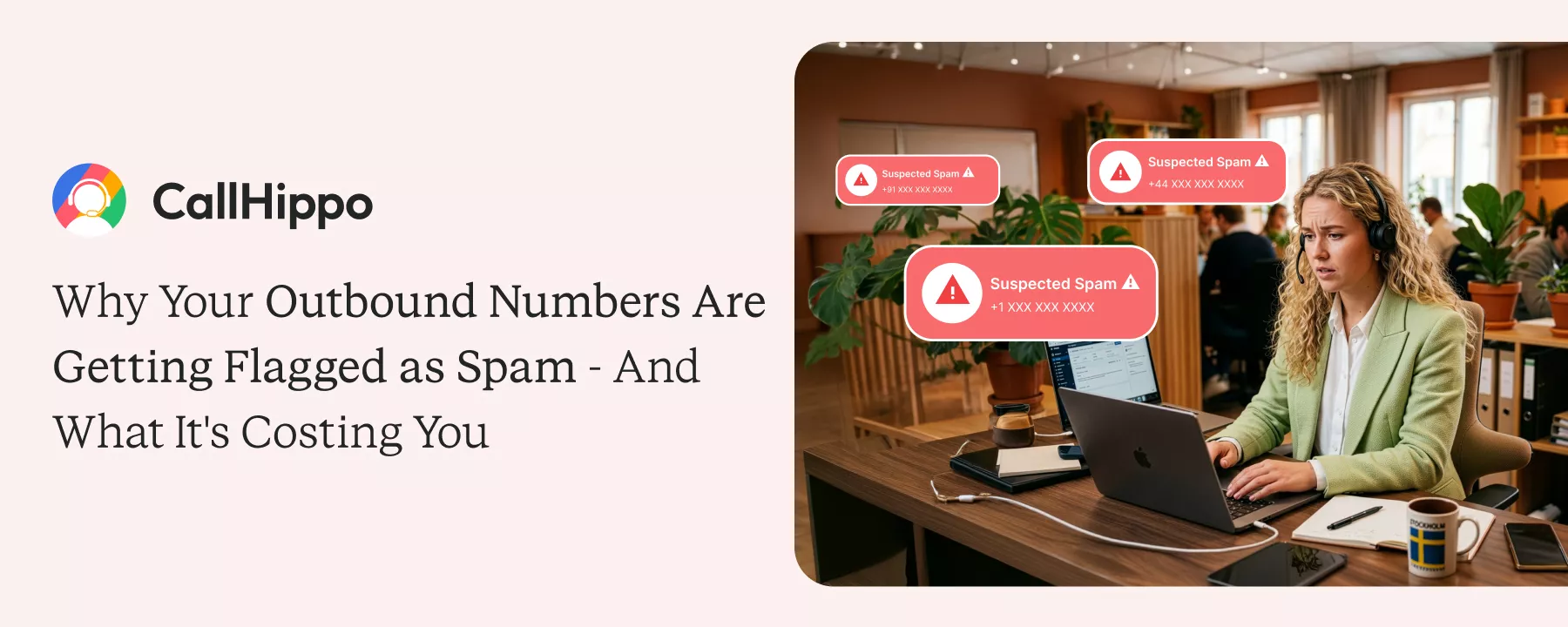
When a number gets flagged as “Spam Likely” or “Scam Risk,” that label only appears on the recipient’s phone. Your rep’s screen looks completely normal. They log “no answer” and move on. The real reason never surfaces in your CRM.
This is exactly why outbound teams are starting to rely on systems that monitor caller ID reputation in real time, instead of discovering the problem weeks later through falling connect rates.
For most high-volume outbound numbers, spam flagging becomes the default state within 60 to 90 days of heavy use.. A new number can start accumulating flags within the first week. By the time the pattern shows up in your connect rate data, you’ve already lost weeks of pipeline.
Managers blame the list quality. They try new scripts. They push for more dials. None of it helps, because the problem isn’t the message. It’s whether the call is getting answered at all.
What This is Actually Costing You
This is worth modeling out, because the numbers are more significant than most sales leaders expect.
Take a team of 50 reps running 150 dials per day. That’s 7,500 calls daily. A 5-point drop in connect rate, from 12% down to 7%, doesn’t sound dramatic. But here’s what it looks like in practice:
| Before flagging | After flagging | |
|---|---|---|
Multiply your average deal size by 2,250 fewer meetings, and the revenue impact becomes hard to ignore. The question is whether you find it now or wait until it shows up in the next quarter.
More importantly, this loss is preventable. With the right calling infrastructure, teams can detect when numbers start getting flagged and automatically shift outbound traffic before call connect rates drop.
How to Find Out if This is Already Happening?
Start with three quick checks before you change anything else about your outbound motion:
1. Check your Connect Rate Trend
Pull the last 90 days and compare it to the 90 days before. A drop of more than 15 to 20 percent, with no change in list quality or headcount, points to a number reputation problem rather than a market or messaging one. If the decline is concentrated on specific numbers rather than spread evenly across the team, those DIDs are almost certainly flagged.
2. Run your Numbers Through the Free Caller Registry
Maintained by Hiya, First Orion, and TNS, the same analytics platforms the major carriers use. Anything flagged there is what your prospects are seeing before they decide not to pick up.
3. Call your own Outbound Numbers from a Personal Cell Phone
What shows up on your screen is exactly what every prospect on your team’s list is looking at.
What Actually Fixes it
There’s a baseline every outbound team should have in place:
- STIR/SHAKEN registration so your calls carry A-level attestation with major carriers
- CNAM records so your company name appears on the recipient’s screen instead of an unknown number
- Gradual number warm-up for new DIDs rather than dropping them straight into full-rotation dialing
- Clean contact lists with sensible retry limits to avoid the velocity spikes that trigger flags
Those fundamentals matter, but they’re table stakes. The harder problem is managing number reputation continuously across a team of 30, 50, or 100 reps with rotating pools and daily dial volume. That’s not something you can audit your way out of once a quarter. It requires a system like Spam Watch that watches reputation in real time and routes calls away from flagged numbers before the damage reaches your pipeline.
This is where platforms like CallHippo come in. By continuously monitoring number health, detecting early spam signals, and automatically rotating outbound numbers, teams can maintain high connect rates without manually auditing every DID or dialing pattern.
The teams that solve this don’t just recover their connect rates. They stop losing ground they didn’t know they were losing in the first place.
How Carriers Decide to Flag Your Numbers
Carrier analytics platforms, Hiya powers AT&T, First Orion powers T-Mobile, and TNS powers Verizon, score numbers in real time based on behavioral patterns, not intent. The signals they watch for:
1. Call Volume
More than 100 to 150 dials per number per day start triggering most algorithms. At 200+ dials from a single number, flagging is nearly guaranteed. Teams running an auto dialer hit these thresholds faster than any manual dialing motion, which makes number rotation and reputation monitoring a required part of the setup, not an optional add-on.
2. Low Answer Rates and Short Call Durations
A number that places 500 calls and gets answered on 50 of them looks like spam, regardless of what’s being said on those calls. Short conversations, under 10 to 15 seconds, reinforce the pattern.
3. STIR/SHAKEN Attestation
STIR/SHAKEN assigns every call an attestation level: A, B, or C.
- Level A means the carrier has fully verified the caller and their right to use that number.
- Level B means the caller is verified, but the number assignment is not fully confirmed.
- Level C means minimal verification.
Calls with B or C attestation are more likely to get flagged or filtered.
4. User Reports
When a recipient taps “Report Spam,” that signal feeds directly into carrier analytics. On some networks, three to five reports in a short window is enough to label a number.
5. Number History
DIDs purchased from VoIP providers often come with a prior history. If the previous user had that number flagged, you’ve inherited their reputation.
Why Mid-Market Teams Get Hit the Hardest
Small teams rarely dial at volumes that trigger carrier algorithms. Large enterprise teams have telecom ops dedicated to monitoring this. Mid-market teams, anywhere from 20 to 150 reps, sit in the worst position. High enough volume to trip the flags, not enough infrastructure to catch them.
A few dynamics make it worse at this scale.
1. Shared number pools amplify the damage.
When your reps share a pool of outbound DIDs, one rep’s calling pattern affects everyone. If someone dials aggressively from a single number for a day, that number gets flagged and the next rep to use it inherits a spam label they don’t know exists.
2. CRM sync issues can spike your velocity without anyone noticing.
If your integration misfires and sends the same lead to two reps, or triggers automatic retries on failed calls, you can end up with four calls to the same number in an hour. Carrier systems flag that pattern immediately.
3. No one owns this problem.
In most mid-market orgs, caller ID reputation sits in the gap between sales ops, IT, and RevOps. Everyone assumes someone else is watching it. Usually, no one is, until connect rates crater.
How CallHippo Helps You Stay Off Spam Lists
Outbound teams do not lose connect rates overnight. It happens gradually as numbers get flagged, reputation drops, and calls start getting ignored without any visible signal inside your CRM.
CallHippo is built to prevent that from happening in the first place.
- Monitor the number reputation continuously instead of relying on delayed performance signals
- Detect early spam indicators before connect rates start dropping
- Automatically rotate outbound numbers to avoid overuse and flagging
- Maintain clean dialing patterns across teams, even with shared number pools
- Ensure better call authentication and visibility with proper setup and infrastructure
Instead of reacting to falling connect rates, your team stays ahead of the problem.

Published : April 7, 2026

Uzma is an SDR Leader at CallHippo with a proven track record in global sales and lead generation. She works closely with sales and support teams to bridge the gap between conversations and revenue by optimizing outreach, improving connect rates, and streamlining communication workflows. Her expertise lies in building scalable calling strategies that drive consistent pipeline growth.

Subscribe to our newsletter & never miss our latest news and promotions.
 24k+ people have already subscribed