
 Updated : July 29, 2026
Recruiting agencies scale until their calling setup breaks.
The moment a second country enters the picture, candidates stop answering, consent logs disappear, and CRM sync falls apart.
This blog unpacks why it happens and how to fix it before compliance or churn catches up.
Recruiting Agencies Can’t Scale Candidate Calls Across Countries
Recruiting agencies scale until three gaps appear: no local caller IDs, no contact history, and no consent records. The moment a second country opens, all three show up together.
1. Unrecognized Numbers Go Unanswered
Recruiters dial from foreign caller IDs, and candidates in the target market treat those numbers as spam. Answer rates fall, and the recruiter has no way to change the outbound caller ID.
2. No Record of Prior Contact Attempts
Ten recruiters share a hot list. And because they have no prior contact attempts, three of them end up calling the same candidate. And that is not it; the fourth recruiter is ready to contact the same candidate everyone else has already had a conversation with.
3. No Proof of Candidate Consent
GDPR, TCPA, and local privacy laws all require consent for outbound contact. A recruiter using a personal phone has no audit trail. When a candidate asks how the recruiter got their number, the agency has no answer.
Why Your Current Calling Setup Breaks Down
The pattern isn’t a recruiter problem, but a tools problem. Consumer apps and personal mobiles were never built for cross-border business.
1. No Local Caller ID by Country
Personal mobiles show one number, one country code. International calling apps route through their own foreign-looking numbers. There is no way to buy local phone numbers in each country and rotate through them intelligently.
2. No Audit Trail for Compliance
Basic apps don’t log calls in a compliance-grade way. Many US states and countries require dual-party consent to record calls, meaning both parties must knowingly agree. Without a logging system, that requirement goes unmet on every call.
3. No Sync With Your CRM or ATS
Recruiters live inside Bullhorn, Greenhouse, or Loxo. Their personal phones don’t. Every call gets logged manually or not at all, leaving the candidate history fragmented across three places.
What This Really Costs Your Agency
The gaps above translate into measurable dollar impact across four categories.
| Symptom | Cost |
|---|---|
1. Lower Answer Rates on Outreach
Unfamiliar international numbers get ignored. Local answer rates typically sit at 20-30%. Foreign caller IDs drop that to 6-8%.
So, if you make 200 calls weekly from a local number, you can have 50 real conversations. And if you make the same number of calls from a foreign one, you have only 15 real conversations.
2. Hours Lost to Manual Call Logging
Recruiters pasting notes into an ATS lose about an hour a day. Across a ten-person team, that’s a full-time role’s worth of productive time each week, spent on data entry.
3. Exposure to Compliance and Fines
TCPA violations run $500 to $1,500 per call. GDPR fines can reach €20 million or 4% of revenue. Agencies usually don’t see the risk until a candidate files a complaint or an auditor asks for records.
4. Slower Candidate Placement Velocity
When an agency opens a new country, outreach stalls for weeks. No local numbers, no local consent tooling. Placement velocity in that market lags because the calling infrastructure never caught up.
The Fix: A Calling System Built for Recruiting Teams
The solution isn’t hiring more recruiters. It’s a calling infrastructure built for cross-border recruiting.
1. Local Numbers in Every Country
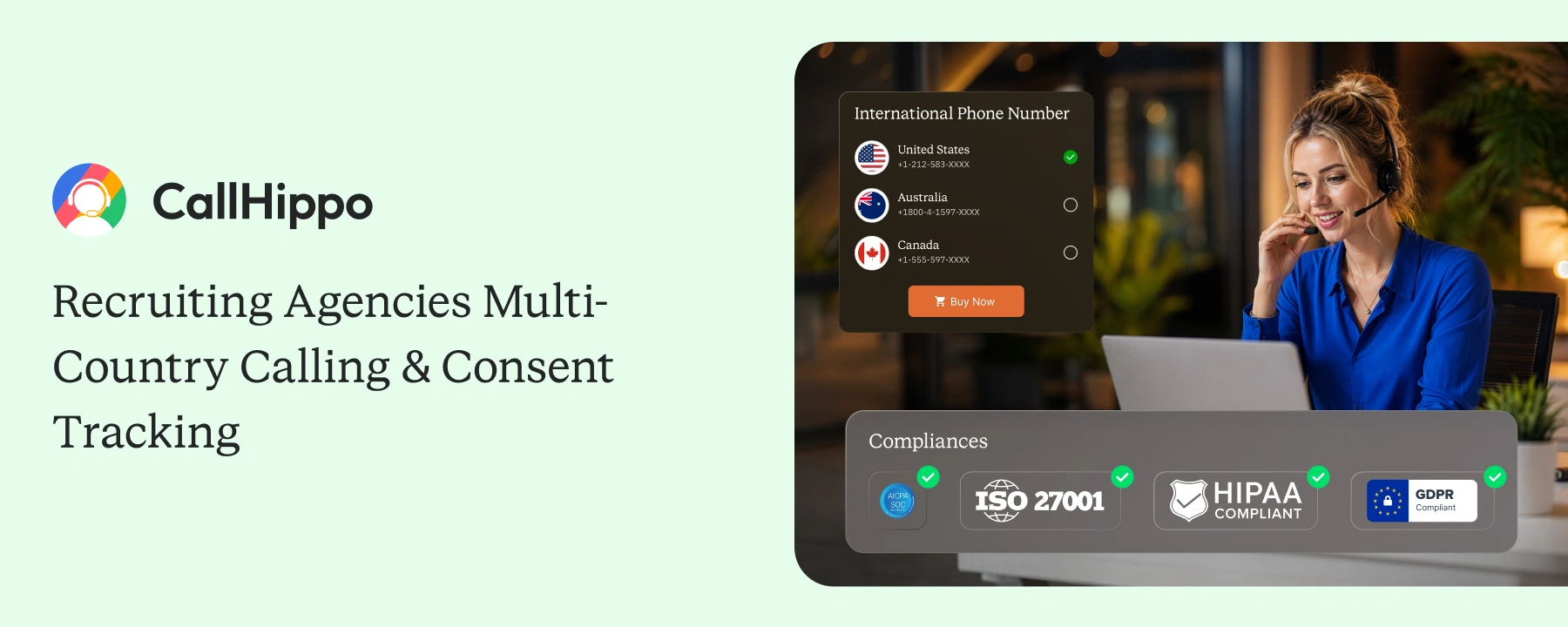
CallHippo provides local and international phone numbers across 150+ countries. Recruiters call from a UK “020” number when reaching London candidates and a Dubai “04” when reaching UAE candidates. Answer rates climb the moment the caller ID matches.
2. Click-to-Call Built Into Your CRM
CallHippo integrates natively with 100+ CRMs and ATSs. Every dial launches from the candidate record. The call, notes, disposition, and recording sync back automatically.
3. Automatic Consent and Call Records
Call Recordings and Audit Logs create a searchable compliance record for every candidate contact. A consent disclosure plays automatically at the start of each call. Country Blocking prevents outreach to jurisdictions your agency doesn’t operate in.
How to Set It Up
Running a sales team without a phone system is flying blind. Deploying the right one across a recruiting agency takes four ordered steps.
- Map your target countries first: List every country where the agency runs candidate pipelines. Buy local phone numbers for each before onboarding recruiters to the platform.
- Connect click-to-call to your CRM: Enable the CallHippo integrations. Set every dial to auto-launch and auto-log by default.
- Turn on call recording by default: Enable Call Recordings on all outbound campaigns. Configure the automatic consent disclosure. Audit Logs become the compliance trail auditors ask for.
- Set country and access controls: Configure Role-Based Access Control by market. Use Country Blocking to prevent dials into jurisdictions the agency isn’t licensed to operate in.
Conclusion
Cross-country recruiting works when the calling infrastructure catches up with the business. Local numbers, native CRM sync, and compliance-grade consent logging turn scaling into a repeatable playbook. Every recruiter reaches candidates faster, and every audit request has a clean answer waiting.

Frequently Asked Questions
1. Do recruiting agencies need two-party consent to record candidate calls?
Yes in twelve US states, all GDPR regions, and several APAC markets. Single-party consent is risky for any agency operating across borders.
2. What’s the difference between call tracking and call recording for compliance purposes?
Call tracking logs metadata: who called whom, when, and for how long. Call recording captures the audio itself. Most compliance frameworks require both.
3. Can a recruiting agency use one phone system for both client-facing and candidate calls?
Yes, and most should. Separate systems create data silos, doubled admin, and fragmented compliance records. A unified platform with role-based permissions handles both.
4. How many countries does a mid-size staffing agency typically need local numbers in?
Most mid-size agencies need 5 to 15 country-specific numbers. US, UK, Canada, India, and several EU markets are the most common footprint.
5. What happens to consent records when a recruiter leaves the agency?
Records stay with the agency, not the individual. Cloud platforms store every call and consent log at the account level. Departing recruiters take nothing with them.
6. Is click-to-call from an ATS different from a regular VoIP dialer?
Yes. Click-to-call inside an ATS launches from a candidate record and auto-logs back. A generic VoIP dialer requires manual copying and disposition entry every time.
Published : July 29, 2026

Satyaki is an SDR Lead at CallHippo with over three years of experience in B2B and B2C SaaS sales, specializing in lead generation, pipeline management, and international markets. Passionate about building meaningful connections, he brings a strategic yet people-first approach to driving business growth.

Subscribe to our newsletter & never miss our latest news and promotions.
 24k+ people have already subscribed