
 Updated : March 17, 2026
Are your contact customer service tickets piling up? Are your customers complaining about them reaching the wrong agent?
If so, nine times out of ten, an active call forwarding rule is the reason.
For businesses, a misdirected call means a missed important call, a frustrated customer, or a dropped SLA.
This guide gives clarity on how to turn off call forwarding. Dial codes, device steps, VoIP dashboards, desk phones; it’s all here.
Pick your scenario and get your calls routing correctly again.
Why Call Forwarding Gets Stuck On? (and When to Turn It Off)
Forwarding rules don’t disable themselves. A few business scenarios keep them running longer than they should.
- An employee set forwarding before a leave. They’re back. Nobody reset the rule. Calls still go to their personal number.
- An admin configured holiday routing. The holiday passed. The routing rule didn’t get removed. The team still wonders why calls aren’t coming in.
Conditional forwarding is on by default. Carriers activate forward-when-busy or forward-when-unreachable automatically. It looks like a configuration error, but it’s a default setting.
Not sure which applies to your situation? Use this quick check:
| What You're Seeing | Likely Cause |
|---|---|
Identified your scenario? Now, here’s what you need to do to fix it.

Take control with CallHippo! Manage all forwarding rules and team routing from one dashboard, instantly
Universal Call Forwarding Deactivation Codes
These are the fastest fixes to stop forwarded calls. No dashboards, no settings menus. Just dial, press call, and wait for the confirmation tone.
1. ##21#: Erase All Forwarding Rules (Works on Most Networks)
##21# code cancels unconditional call forwarding on most GSM networks. All calls, always-forward rule, everything gone, within seconds.
- Open the phone dialer
- Type ##21#
- Press call
- Wait for the confirmation screen
- Hang up

T-Mobile recommends this as the primary call forwarding deactivate code.
2. *73: Cancel No-Answer Forwarding (US Carriers)
*73 is the standard call forwarding deactivate code across US carriers. It cancels no-answer and standard forwarding in one step. Verizon and AT&T phone companies both support it.
- Dial *73
- Press call
- Listen for the stutter confirmation tone
- Hang up
3. Carrier-Specific Codes: AT&T, Verizon, T-Mobile, Vodafone, Jio
Different carriers use different codes to deactivate call forwarding. Let’s explore the unique codes used.
| Carrier | Deactivation Code | Region |
|---|---|---|
These are free USSD commands. No charge and no data usage. They work on business lines the same as personal ones.
 : Difference:Call Transfer vs Call Forwarding vs Call Divert
4. ##004#: International Conditional Forwarding Reset
This targets conditional forwarding only for busy, no-answer, and unreachable rules. It’s the right code when voicemail picks up too fast or calls skip certain agents.
- Dial ##004#
- Press call
- Confirm the success message
- Hang up
Want to check the status before resetting? Dial *#21# to see unconditional forwarding status. Dial *#67# for forward-when-busy.
: International Call Forwaring AppsHow to Turn Off Call Forwarding on iPhone?
Call forwarding can help if you need to direct incoming calls to another number. But if you no longer need it, you need to turn it off. Let’s see how you can turn off call forwarding on your iPhone with quick and easy steps.
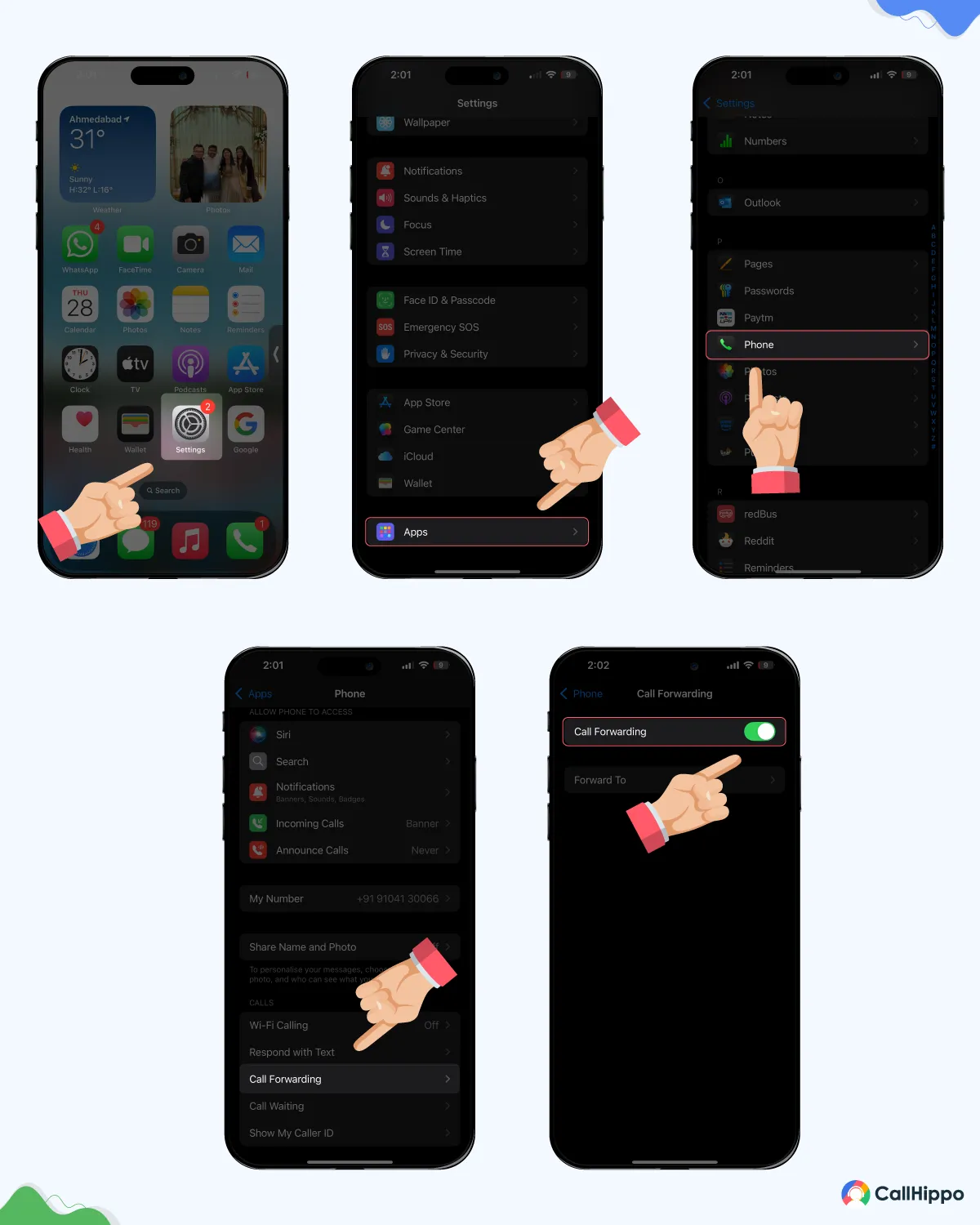
1. Using Phone Settings (iOS)
Using phone settings is the easiest way to turn off call forwarding on iPhone. We take just a few seconds to turn off call forwarding. Here’s what you need to do:
- Open Settings
- Tap Phone
- Tap Call Forwarding
- Toggle it off
The toggle takes two to five seconds to update. Your iPhone communicates with the carrier network to confirm the change. Don’t exit too quickly.
2. Using a Deactivation Code on iPhone
Some carriers hide the Call Forwarding option in iOS settings entirely. Verizon is the most common example. Use a code directly from the keypad instead:
- *73 – AT&T, Verizon
- ##21# – T-Mobile
- ##002# – Universal fallback
The code bypasses iOS entirely. It sends the command directly to the carrier network.
How to Turn Off Call Forwarding on Android?
Android devices make it easy to manage call forwarding for incoming calls. You can turn it off in just a few steps from the phone’s call settings. Here’s how.
1. Stock Android (Google Pixel, OnePlus)
Almost all Android devices follow the same steps or process when it comes to turning off call forwarding.
- Open the Phone app
- Tap the three-dot menu
- Go to Settings, then Calls
- Tap Call Forwarding
- Tap Always Forward, then Turn Off
Also, disable the remaining conditions: forward when busy, unanswered, and unreachable. Each needs to be turned off individually.
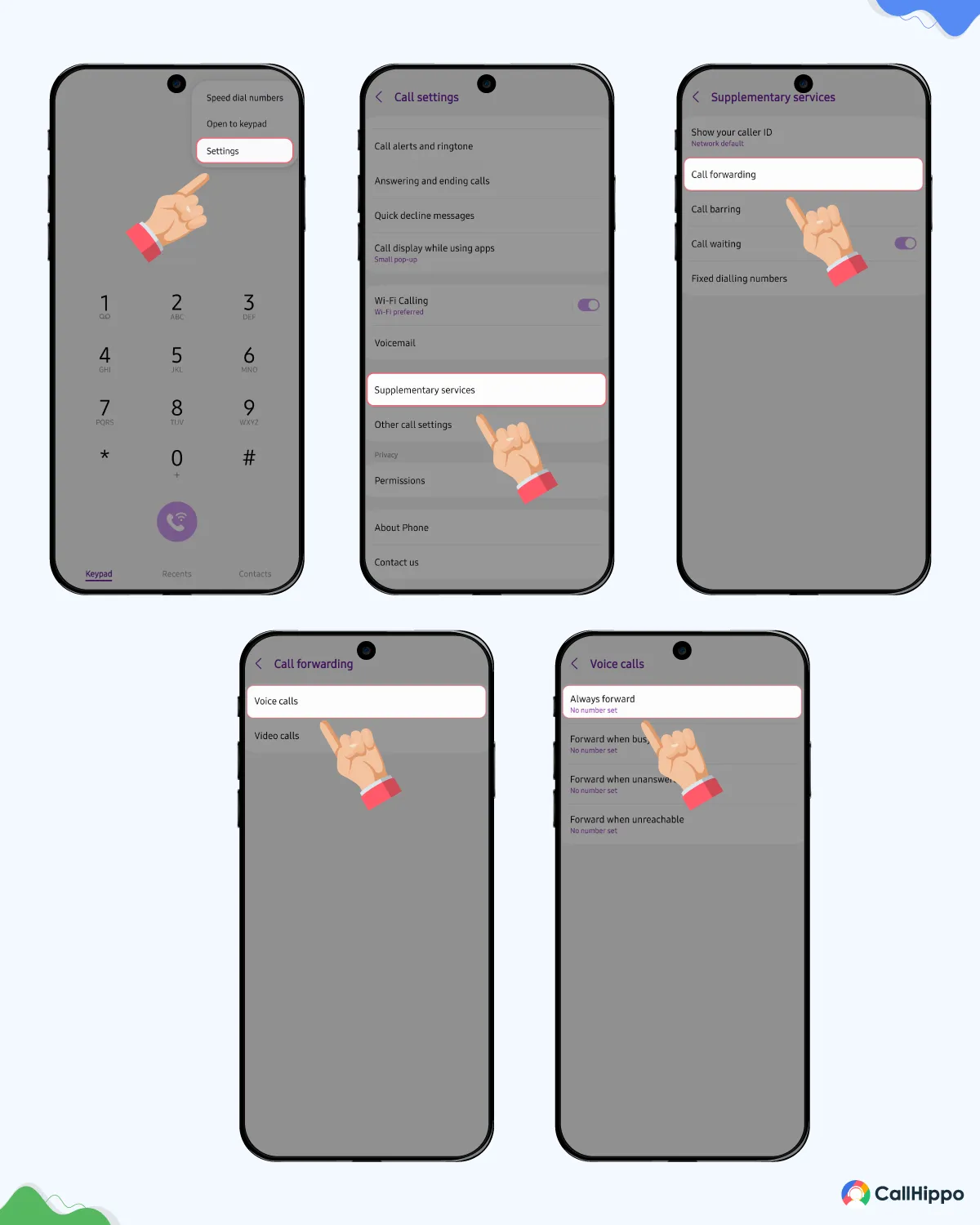
2. Samsung Galaxy
Samsung Galaxy is also an Android device, but it follows a slightly different process to turn off call forwarding. Let’s see what steps you need to follow to turn off call forwarding if you use a Samsung Galaxy device.
- Open the Phone app
- Tap the three-dot menu, then tap Settings
- Tap Call Forwarding
- Tap each forwarding type and select Disable
3. Using a Deactivation Code on Android Phones
We got an understanding of how to turn off call forwarding via Android device settings. Now, let’s understand how the deactivation code can help you turn off call forwarding on Android.
- Open the dialer
- Type ##21# or ##002#
- Press call
- Wait for “Erasure Successful” on screen
Just four steps, and your call forwarding can be turned off. For many, dialing a deactivation code can be more convenient in comparison to turning off call forwarding from Android settings.
How to Turn Off Call Forwarding on a Landline or Desk Phone?
Many landline and desk phones allow users to turn off call forwarding quickly. Users can easily stop call forwarding to restore normal call routing. Let’s see how.
1. Using Keypad Codes on a Landline
There are multiple processes that help you turn off call forwarding for different phones, systems, and rules. Each process is simple; what makes the difference is that you know the right process for the right device and rule. Let’s see how to turn off call forwarding on a landline.
- Lift the handset
- Wait for the dial tone
- Dial *73
- Listen for two short confirmation beeps
- Hang up
2. Desk Phones (Cisco, Polycom, Avaya)
Desk phones such as Cisco, Polycom, and Avaya come with built-in call forwarding features. Disabling it is simple and can usually be done directly from the phone’s settings menu. Below is the process you must follow to turn off call forwarding on different desk phones.
- Cisco IP Phones: Press More softkey > CallFwd > FwdOff
- Polycom VVX: Home screen > Forward icon > FwdOff softkey
- Avaya (9611G and similar): Lift handset > Press #2 > Listen for confirmation tone
If the softkey options aren’t appearing, forwarding is likely managed at the system level. Your IT admin controls it, not the individual device.
: Forward call without your phoneHow to Turn Off Call Forwarding on a Business Phone System?
You can turn off call forwarding on a business phone system by adjusting the call routing or forwarding settings. Let’s see how.
1. Cloud VoIP and PBX Systems
Cloud-based platforms don’t rely on dial codes. Forwarding rules live in the admin dashboard. That’s where you go to change them.
- Log in to your admin dashboard
- Go to Settings or Phone Settings
- Find Call Forwarding or Call Routing
- Locate the active rule
- Toggle it off or delete it
- Save changes
Changes take effect immediately. No restart, no delay. Test with a quick inbound call after saving.
2. Admin-Level vs. User-Level Forwarding Rules
This is where most business teams get stuck. There are two layers of forwarding control in VoIP phone systems.
- User-level: The employee manages it. Visible in their personal settings. They can toggle it themselves.
- Admin-level: Set by the system administrator. Applies across users or departments. Individual users usually can’t see or edit these rules.
If a user turns off forwarding and calls still redirect, an admin-level rule is overriding it. The admin must go into the system and remove the rule at the account level.
This is especially common after:
- Holiday or after-hours forwarding setups
- Office closures or relocations
- Staff changes where a departing employee’s number was forwarded
3. How to Manage Call Forwarding Rules for Your Team in CallHippo?
CallHippo includes call forwarding in its core VoIP feature set. No add-ons, no extra hardware required.
To remove a forwarding rule as an admin:
- Log in to your CallHippo Admin Dashboard
- Go to Manage Numbers
- Select the phone number to update
- Click Settings for that number
- Find the Call Forwarding section
- Toggle the rule off or remove the destination number
- Click Save
For team-wide resets, the admin panel shows all active forwarding rules across every number. You can audit and disable rules for the entire team from one view. Changes apply immediately. Calls route back to the original line the moment you save. Individual team members can manage their own rules under their user profile. Admins retain override access at all times.

With CallHippo, turn off unwanted forwarding, audit team lines, and never miss a customer call again.
Take a 10-Day Free Trial No credit card required!Which Method Is Right for Your Situation? (Quick Decision Guide)
Not sure where to start? Pick your scenario:
| Your Situation | Start Here |
|---|---|
Call Forwarding Still Active? How to Troubleshoot
If your calls are still being redirected after disabling call forwarding, there may be a configuration or network issue. Troubleshooting the settings can help ensure that incoming calls reach your phone directly.
1. When the Code Does Not Work
If the call forwarding code does not work, it may be due to carrier restrictions or incorrect settings. So check your network provider’s instructions. You can also check your phone settings to resolve the issue.
Try these fixes in order:
- Wrong code for your carrier. Use ##002# as the broadest catch-all. It helps you cancel call forwarding for all types on most GSM networks.
- Weak network signal. USSD codes need a signal to reach the carrier. Move to a stronger coverage area and retry.
- SIM issue. Remove the SIM, wait 30 seconds, reinsert it, and try the code again.
- Airplane mode reset. Enable airplane mode for 10 seconds. Turn it off. Try the code immediately after reconnecting.
2. Check for App-Level Forwarding (Google Voice, WhatsApp)
Apps can set carrier-level forwarding rules without making it obvious. Two common culprits:
- Google Voice: Linking a number to Google Voice enables carrier forwarding. Deleting the app does not remove the rule. Open Google Voice > Settings > tap your linked number > disable call forwarding. If the app is gone, dial ##002# or call your carrier directly.
- WhatsApp Business: Check Calls settings inside the app. Some enterprise WhatsApp integrations route calls in ways that mimic forwarding behavior.
Carrier apps: My Verizon, T-Mobile app, and AT&T’s app all have call forwarding settings. Log in and check Account or Call Settings for active rules; the device settings might not show.
3. When to Contact Your Carrier
If call forwarding issues persist after trying it all, it may be best to contact your carrier. This way, you can check for network-level settings or restrictions.
Call your carrier if:
- Every code returns an error
- Forwarding reactivates automatically after disabling
- Settings menus are missing or greyed out
- The issue started after a plan change or carrier update
- You suspect unauthorized forwarding on a business line
When you call, use this exact phrasing: “Please check and reset all call forwarding rules on this line.” It gets you to the right team without lengthy back-and-forth.
Wrapping Up
Misdirected calls cost businesses more than most teams account for. A forwarding rule left active after a holiday, or a system migration, quietly routes customer calls away from your team. Disabling call forwarding is usually quick and only takes a few steps on most devices.
By checking your phone settings or using the right codes, you can easily make sure all calls ring directly on your phone again. In this detailed blog, we have covered all the aspects to turn off call forwarding for all devices and forwarding rules. You can easily turn off call forwarding without any error.
FAQs
1. What is the universal code to turn off all call forwarding?
##002# can cancel call forwarding for all types in one command. Unconditional, busy, no-answer, and unreachable; all get cleared.
2. What does *73 do?
*73 cancels standard and no-answer forwarding on US carriers. It’s the primary code for Verizon, AT&T, and most regional US networks.
3. How do I know if call forwarding is active on my phone?
Dial *#21# and press call. Your phone displays the current forwarding status. Alternatively, check Settings > Phone > Call Forwarding on iPhone, or the Phone app settings on Android.
4. Why won’t call forwarding turn off on my phone?
Four likely reasons.
- Wrong carrier code.
- App-level forwarding is still running (check Google Voice).
- Admin-level rule overrides your user settings.
- A carrier-side configuration that needs a direct network reset.
Work through them in that order.
5. Can someone forward my calls without me knowing?
Yes, but only if they have access to your device or carrier account credentials. On a business line, anyone with admin access to your VoIP dashboard can enable forwarding. You can dial *#21# to check.
6. Does turning off call forwarding affect my voicemail?
It can. Voicemail typically runs through conditional forwarding at the carrier level. Using ##002# or ##004# to reset all conditional rules may disable voicemail routing, too. Use ##21# to cancel only unconditional forwarding. That removes manual redirects without disrupting your voicemail setup.
7. What are the codes to cancel conditional call forwarding?
Here are the call forwarding deactivate codes of each forwarding type:
| Forwarding Type | Cancel Code |
|---|---|
8. How to confirm call forwarding is off?
Here are the three ways that can help you check whether your call forwarding of off or not.
- Dial *#21#, it shows the current status directly on the screen.
- Check Call Forwarding in your phone settings.
- Make a test call to the line from a different number. If it rings on the intended device, forwarding is off.
9. How do I turn off call forwarding for my entire team on a business phone system?
- Log in to your admin dashboard.
- In CallHippo, go to “Manage Numbers” and review forwarding settings for each line.
- Review and clear rules across all users from one view.
For bulk resets, this is the fastest approach. Individual user-level rules require going through each profile separately.
Published : March 17, 2026

Harsh Bairagi is a B2B SaaS content writer with over 4 years of experience in the tech industry. Harsh believes in creating good copies to bridge the gap between tech and emotion. When not chasing clean copy or clever metaphors, he is busy catching up on his favorite sports.

Subscribe to our newsletter & never miss our latest news and promotions.
 24k+ people have already subscribed