
 Updated : March 20, 2026
Your phone number decides whether customers will call you or scroll past your listing. Did you know that a local number with a recognizable area code gets 30% more answer rates in targeted regions? With a toll-free number, you can remove cost barriers for nationwide callers.
Businesses that choose just one number type without understanding both approaches often miss significant opportunities. The real question is not about the better number type. It is more about which strategy matches your customer behavior, market position, and growth plans right now.
What is a Local Phone Number?
A local phone number is a number that has a defined geographic area under the same area code (such as New York, 212, or San Francisco, 415). Companies can use it to establish a recognizable presence in the areas they serve by allowing their customers to call them without requiring them to have an office in the area.
According to a study, consumers are 4 times more likely to answer calls from local area codes compared to unknown toll free numbers. This preference comes from familiarity and trust. People assume that local businesses understand their specific needs and operate in their time zone.

Get local and toll-free numbers on CallHippo to match caller preferences and improve answer rates.
Benefits of a Local Phone Number for Businesses
Local numbers create immediate geographic trust while opening doors for precise campaign tracking. Based on my experience working with regional service providers, here’s what actually works:
1. Builds Trust With Local Customers
People answer calls from numbers they recognize. When your Denver prospect sees a 303 area code, they assume you understand their market, know their neighborhood challenges, and operate on their time zone. A report found that 72% of consumers prefer calling businesses with local phone numbers when searching for local services.
2. Increases Call Answer Rates in Specific Regions
This isn’t theory, it’s measurable. Regional area codes get picked up more frequently than unknown toll free prefixes or out-of-state numbers. Your Austin sales rep calling from a 512 number will connect with more Austin leads than the same rep using an 800 number.
3. Makes Your Business Look More Accessible and Reliable
A local number signals you’re invested in the community. You’re not some faceless national corporation, you’re the business down the street (even if you’re actually operating remotely). This perception matters most for service businesses, real estate agencies, legal practices, and healthcare providers, where proximity builds confidence.
4. Helps You Target Local Markets More Effectively
Testing new markets becomes simple with local numbers. Buy a number in your target city and run local ads. Track which neighborhoods generate calls. Measure conversion rates by area code. You get real market data without signing a lease or hiring local staff. If the market responds well, expand. If it doesn’t, you’ve spent $10-20 monthly instead of thousands on office space.
5. Improves Customer Support With Familiar Area Codes
When customers need help, they want to reach someone nearby. A familiar area code reduces friction. It signals faster response times and better understanding of local issues. Even if your support team works remotely from five different states, displaying the customer’s own area code makes them feel prioritized.
6. Enables Better Campaign Tracking With Regional Number
Having dedicated phone numbers assigned to each local campaign will make it easier for each local area campaign to be identified separately. For example, if you were running a Facebook ad for San Francisco, you would want to create a unique phone number with a 415 area code for that ad campaign. If you were running a Google ad for San Jose, you would create an ad campaign with a 408 area code for that ad.
This way, you’ll have visibility into which types of campaigns are generating the highest volume of calls from specific areas, where your top neighborhoods (the neighborhoods engaging the best with your marketing) are, and how much you want to allocate your advertising budget towards these neighborhoods.
Disadvantages of Local Numbers
Local numbers solve specific problems but create others. Know these limitations before committing:
1. Limited National Reach
A 617 Boston number works great for Boston customers, but creates hesitation everywhere else. Dallas prospects might not answer a Massachusetts area code. Portland callers might assume you can’t serve their region. If you serve customers nationwide, you’ll need multiple local numbers or a different approach entirely.
2. Costly for Non-Local Callers
When someone outside your area code calls your local number, they may pay long-distance rates depending on their phone plan. This matters less now with unlimited mobile plans, but it still creates perceived barriers. Business customers with metered landlines will hesitate before calling your Houston number from their New York office.
3. Hard to Scale Across Regions
Managing one local number is simple. Managing 15 local numbers across 15 cities becomes complex fast. You need systems to route calls correctly, train teams on which number serves which market, and update marketing materials across multiple regions. The administrative overhead grows exponentially as you add locations.
How to Get a Local Phone Number?
Now that you know what a local virtual number is, let’s understand how to install them.
Here’s how you can do that:
- Step 1: Sign up and create your account with CallHippo
- Step 2: Choose a local number or port your existing one.
- Step 3: Make the payment.
- Step 4: Configure your settings by adding team members and setting up call center management features,.
You’re all set to use the number.
When to Choose a Local Number?
You want to use a local phone number if you have a concentrated customer base that is located in a particular geographic area; you may want to use a local number when trust and familiarity are more important than being perceived nationally.
1. You’re targeting a single city or region:
If you are marketing to a specific city (or region), such as a law firm located in Toronto that wants to serve clients in Toronto, you should use a 416 area code. Portland-based coffee roasters who only want to sell to Portland-area cafés should use a 503 area code. A local area code on the phone number immediately conveys to your audience that you belong to their community.
2. You’re testing new markets without major investment:
Before opening a Miami office, buy a 305 number and test customer response. Run ads with that number for 60-90 days. Track call volume, conversion rates, and customer feedback. If Miami responds well, commit resources. If not, you’ve risked almost nothing.
3. Your industry expects local presence:
Real estate, legal services, medical practices, home services, and financial advisors all benefit from local numbers. Customers in these sectors want to know you understand their local market, regulations, and community dynamics. An out-of-state number creates immediate skepticism.
4. You want better Google Business Profile performance:
Google prioritizes businesses with local phone numbers in local search results. A Seattle business with a 206 number ranks higher in “Seattle plumber” searches than the same business with an 800 number. According to a study, having a local phone number matching your business location improves local pack rankings by an average of 8-12%.
5. You’re running location-specific marketing campaigns:
Different neighbourhoods respond to different messages. Use unique local numbers for each campaign to track which messages work where. This lets you optimize spending by doubling down on successful campaigns and cutting unsuccessful ones.
What is a Toll free Number?
A toll-free number is a phone number that allows customers to reach out to a business for free. A toll-free number is not associated with any city. Instead, it is linked with a country. This can help you increase your sales significantly.
The toll-free numbers start with the prefixes like 1800 number and are usually used as the business inquiry number or customer service department number. Thus, the businesses pay for both – incoming and outgoing calls on toll-free numbers.
Another reason to invest in a toll-free number is that it helps increase the chances of brand recall.
For example, the toll-free number of Samsung is 1800-5-SAMSUNG (1800-5-726-7864). You can also choose a toll-free number that represents your brand and increase brand recall.
There are two available options in the toll-free numbers, i.e., a domestic toll-free and an international toll-free number. The domestic toll-free number allows customers from a country to call you for free, while the international toll-free number lets customers from across the world reach out to you for free.
Benefits of Toll free Numbers for Businesses
Toll-free numbers help you provide better customer service, enhance brand image, are a great marketing tool, and reduce operational costs. Let’s understand the advantages of toll-free numbers in detail.
1. Improves Customer Service
Many customers prefer to communicate with the business before making a purchase. This call is the companies’ first and often the last chance to convert the lead. The toll-free numbers provide much-needed support to the customers as they can reach the businesses without paying anything. This also comes in handy when the customer wants to solve an issue after making the purchase.
2 Enhances Brand Image
At the most basic level, having a free number that customers can call anytime and get their issues solved makes your company look good. Besides, toll-free numbers are recognized as business contact numbers, and any organization using them is less likely to be seen as a small-time operation.
3 Can Be Used As A Marketing Tool
Google says that many customers engage with businesses directly through the “click-to-call” feature. This means that by promoting your business using the toll-free number, you can maximize the number of callers.
4 Helps Improve Your Products and Services
Like local virtual numbers, toll-free numbers come with several useful features like call recording, call monitoring, and real-time analytics. You can use these features to gather actionable and valuable data about your customers and improve your offerings accordingly.
5 Cost-effective
Cloud-based toll-free numbers are easy to configure and accessible by businesses of all sizes. Besides, they cost less than traditional phone services. This makes it easier even for startups to acquire a toll-free number and give the benefits to their customers.
6- Integrates With Your Business Tools
You can easily integrate your toll-free number with other business applications and create a connected workplace. This will help improve the productivity and efficiency of your sales and support teams as they’ll be able to access necessary customer data without hopping between tools.
How to Get a Toll-Free Number?
Now that you know what a toll-free number is and why you should invest in one, let’s understand how you can get it.
The process is similar to getting a local virtual number. All you have to do is follow these steps.
- Step 1: Sign up and create your account with CallHippo
- Step 2: Choose a toll-free number or port your existing one.
- Step 3: Select a plan.
- Step 4: Configure your settings by adding team members and setting up call center management features,.
You’re all set to use the number.
Disadvantages Of a Toll-free Number
Toll-free numbers are not foolproof. They also have certain disadvantages, such as unnecessary calls, and are not a standalone medium for calling.
1- Unnecessary Calls
Since calling your company becomes free, it might result in many unsolicited calls. Miscreants can use it to their advantage during their leisure time. This might make it difficult for your agents to deal with people who are not interested in your products and services.
2- Is Not a Standalone Medium
You cannot just keep a toll-free number to boost your sales number. You’ll also have to use local phone numbers for sales and establish a robust local presence.
Domestic vs. International Toll free Numbers
Domestic toll free numbers work only within their home country. A US toll free number (1-800) works for callers in the United States and Canada. Someone in the UK can’t dial it. Someone in Australia can’t reach it. These numbers cost less and suit businesses serving single-country markets.
International toll free numbers (ITFS) let customers from multiple countries call you for free. A caller in Germany dials a German toll free prefix that routes to your business. A caller in Japan dials a Japanese prefix that reaches the same destination. You manage one number, but it works across multiple countries.
The cost difference is substantial. Domestic toll free numbers offer fewer restrictions and more affordable costs compared to international toll free numbers. International toll free service typically costs 5-10 times more per minute, depending on the countries you support.
When to Choose a Toll free Number?
You should choose a toll free number when you serve customers across multiple states and need to project national capability.
1. You serve customers nationwide:
E-commerce businesses, SaaS companies, national service providers, and businesses without geographic limitations should default to toll free. It removes regional barriers and simplifies marketing across state lines.
2. You’re running national advertising campaigns:
TV commercials, national radio, podcast sponsorships, and broad digital campaigns all work better with toll free numbers. Customers don’t need to remember whether you’re in their area code; the number works the same everywhere.
3. Customer service is your primary use case:
Support lines should always be toll free. Customers calling for help should not pay for that privilege. This single decision improves customer satisfaction metrics and reduces churn.
4. You want to project enterprise credibility:
Competing for enterprise contracts? Selling to large organizations? An 800 number signals you’re established, stable, and capable of serving their needs. It’s a small detail that opens doors in initial conversations.
5. You need one memorable number for all marketing:
It is complex to manage multiple local numbers across marketing channels. One toll free number simplifies everything. You can have one number on your website, business cards, email signatures, and advertisements.
Way to Reach You
- 1National Coverage
- 2Brand Credibility
- 3Better Customer Support
- 4Quick Setup
What is the Difference Between Toll free and Local Numbers?
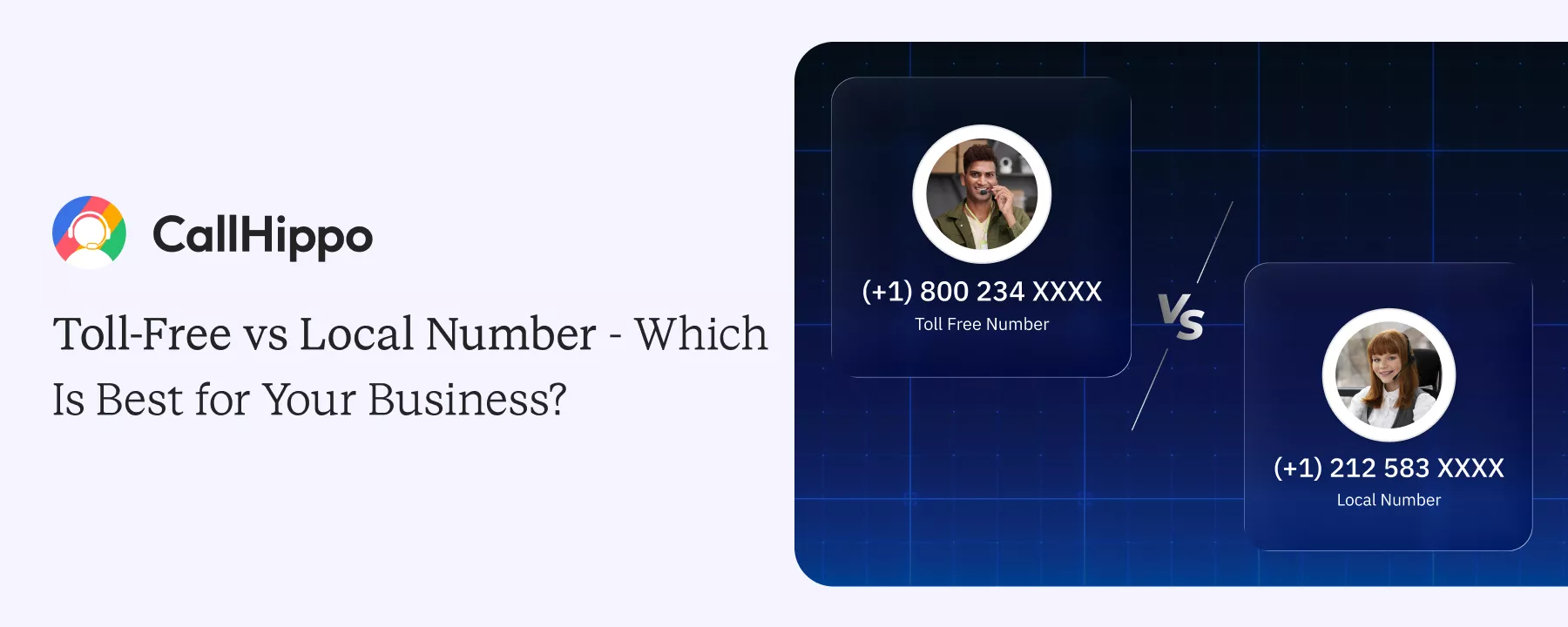
The toll free vs local number decision affects customer behavior, brand perception, and operational costs in ways most businesses underestimate. Here’s how they compare across key factors:
| Factor | Local Number | Toll Free Number |
|---|---|---|
How to Choose Between a Toll free and Local Number for your business?
The decision framework matters more than general advice. Based on my work with multiple businesses, ask these questions:
1. Identify Your Target Audience
Map where your customers live. If 80% cluster in three cities, buy local numbers for those cities. If they’re spread across 20 states, go toll free. Pull your CRM data. Check your website analytics. Look at shipping addresses. The geographic distribution tells you which number type matches your reality
2. Define Your Brand Identity
What do you want customers to think when they see your number? Local and approachable? Use a local number. Large and established? Go toll free. Your number should reinforce your positioning, not contradict it. A boutique local bakery loses credibility with an 800 number. A national logistics company loses credibility with a single city area code.
3. Consider Your Geographic Reach
Current reach matters less than planned reach. If you serve one city now but plan to expand to five cities within 18 months, think ahead. Starting with local numbers and switching to toll free creates confusion and wastes the brand equity you’ve built. Starting with toll free from day one simplifies future expansion.
4. Evaluate Customer Call Costs
Do your customers have unlimited calling plans (most mobile users) or metered landlines (some business users)? Metered customers hesitate before calling long-distance. Free calls from toll free numbers eliminate this hesitation. This matters most in B2B contexts where customers call from office landlines with per-minute pricing.
5. Align the Number Type With Your Marketing Goals
Different campaigns need different numbers. Local SEO and Google Business Profiles perform better with local numbers. National TV ads work better with toll free numbers. Social media campaigns can use either depending on the targeting. Match the number type to how customers will discover it.
Can Businesses Use Both Number Types Together?
Yes, and most successful businesses do exactly this. I recommend this hybrid approach to almost every client who serves multiple geographic markets.
Use local numbers where local presence matters. Display them on Google Business Profiles, location-specific landing pages, and regional advertising. These numbers get better answer rates from local prospects and improve local SEO rankings.
Use toll free numbers where national reach matters. Put them on your main website, national advertising, and customer support pages. These numbers work for everyone regardless of location and project professional credibility.
CallHippo makes this simple. You can purchase both local and toll free numbers from a single platform. Route calls based on customer location, time of day, or agent availability. Track which number type drives more conversions. Test different approaches without rebuilding your entire phone system. The flexibility lets you optimize based on real performance data. You don’t have to guess which number type works better.
The platform handles all the technical complexity, like number porting, call routing, analytics, and integration with your CRM. You focus on which number to show to which customers. CallHippo handles everything behind the scenes.
Compliance & Regulatory Considerations for Local vs. Toll free Numbers
Phone number compliance isn’t optional. With violations, you can trigger fines, carrier blocks, and reputation damage. Here’s what you need to know:
1. Caller ID & Number Display Regulations
Your caller ID must accurately represent your business. You cannot display a local number you don’t own. You can’t spoof different numbers to manipulate answer rates. The TRACED Act and STIR/SHAKEN regulations require authentication of caller identity. You should only use numbers registered to your business and display them consistently.
The Federal Communications Commission (FCC) has acted vigorously in enforcing regulations concerning caller ID spoofing. The organization imposed nearly $300 million in fines for violations of the law in 2023 alone. The Truth in Caller ID Act, as part of its provisions, imposes penalties for an individual who falsifies a caller ID for fraudulent purposes, of a possible maximum of $10,000 for each infraction or violation thereof.
2. Anti-Spam & Do-Not-Call Compliance
Both your local and toll free numbers must comply with Do-Not-Call regulations. You have to scrub your calling lists against national and state registries. You must maintain your own do-not-call list. Also, honor opt-out requests immediately. The FTC fines violators up to $50,120 per violation. Document your compliance processes and train your team on requirements.
The Telephone Consumer Protection Act (TCPA) also requires prior express written consent before making autodialed or prerecorded calls to cell phones. Keep records of all consents for at least four years.
3. Geo-Restrictions for Local Numbers
Some countries require proof of local business presence before issuing local numbers. You might need a local address, business registration documents, or utility bills showing physical presence. These requirements vary by country and sometimes by region within countries. Check documentation requirements before purchasing international local numbers.
4. Toll free Number Usage Rules
Toll free numbers are usually only reachable from within their home country and generally cannot be dialed from other countries. Don’t advertise a US toll free number as an international contact option. Customers outside the country can’t reach it. Use international toll free numbers or local numbers in each country you serve if you need global reachability.
5. Call Recording & Monitoring Laws
Call recording rules differ by state and country. Some jurisdictions require two-party consent (both the caller and the business must agree to the recording). Others allow one-party consent (businesses can record if they notify the caller). Your IVR system should announce the recording before customers speak to agents. Document which calls you record and why. Store recordings securely and delete them according to retention policies.
In the US, eleven states require two-party consent: California, Connecticut, Florida, Illinois, Maryland, Massachusetts, Montana, New Hampshire, Pennsylvania, and Washington. Violating these laws can result in civil lawsuits and criminal charges.
6. Emergency Calling Limitations
Neither local nor toll free virtual numbers support emergency services (911 in the US) by default. If employees work remotely using your business phone system, ensure they understand they cannot dial emergency services through the business line. They must use personal phones or landlines for emergency calls. Some VoIP providers offer E911 service as an add-on; enable this if employees rely on business phones as their primary communication tool.
Your Next Move in Smarter Communication
The toll free vs local number debate misses the point. After working with hundreds of businesses over the past years, I’ve learned the question isn’t which number type wins: it’s which combination of both drives the most customer contact at the lowest cost while building the brand perception you want.
CallHippo simplifies this entire process. You get access to both local numbers (covering 2,500+ cities globally) and toll free numbers (supporting 50+ countries) from one platform. The system includes AI-powered features like automatic call transcription, sentiment analysis, and intelligent call routing that connect customers to the right agent based on their needs and history.
The AI copilot listens to calls in real-time and surfaces relevant customer information to agents during conversations. Post-call summaries are generated automatically. Call analytics identify which numbers perform best, which campaigns drive the most revenue, and where to optimize your phone strategy. You see exactly which number types work for which customer segments.
Set up takes minutes, not weeks. Port existing numbers or buy new ones. Route calls based on business hours, agent availability, or customer location. Integrate with your CRM so every call syncs automatically. Scale up when you’re ready without replacing your system or retraining your team.
CallHippo’s platform includes built-in compliance tools to help you meet TCPA, Do-Not-Call, and caller ID authentication requirements. The system automatically logs consent, manages opt-outs, and validates caller IDs before calls go out.
- Audit which phone numbers you currently display across all customer touchpoints: website, Google Business Profile, social media, email signatures, and advertising. Document which number types you use, where, and why. This 15-minute audit reveals gaps, inconsistencies, and opportunities to optimize your phone strategy immediately.
FAQs
1. What is the main difference between a local number and a toll free number?
Local numbers have area codes tied to specific cities, and customers pay for calls. Toll free numbers have 800-prefix codes, work nationwide, and the business pays for all incoming calls, making them free for customers to dial.
2. Which number type is better for small businesses?
Local numbers work best for small businesses serving specific cities or regions, especially service providers, retail stores, and professional services. They build local trust and improve answer rates in targeted areas without high incoming call costs.
3. Can I get both a local and toll free number for my business?
Yes. Most businesses use both: local numbers for regional marketing and outbound sales calls, toll free numbers for customer support, and national campaigns. This hybrid approach captures both local trust and national reach.
4. Do local numbers increase call answer rates?
Yes, significantly. Local area codes get higher answer rates than unfamiliar toll free or out-of-state numbers because customers recognize and trust numbers from their own region. This effect is strongest for sales and initial contact.
5. How quickly can I get a business phone number?
With VoIP providers like CallHippo, you can purchase and activate local or toll free numbers in minutes. Number porting from existing providers typically takes 7-14 business days, depending on your current carrier and number type.
6. Does a Toll free number work internationally?
Standard toll free numbers work only within their home country. International toll free numbers (ITFS) let customers from multiple countries call you free, but they cost more. Choose based on your customer locations and budget.
7. How many local or Toll free numbers can a business have?
There’s no practical limit. Businesses often use 10-50+ local numbers for different cities or campaigns, plus multiple toll free numbers for different departments. Your VoIP provider manages all numbers through one platform and one bill.
8. How many local or toll free numbers can a business have?
Yes, through number porting. You submit a porting request with your current account details, and the new provider coordinates the transfer. Toll free numbers port more reliably than local numbers because they’re managed in a centralized national database.
9. Do I need any hardware to use a virtual local or toll free number?
No hardware required. Virtual numbers work through internet connections on computers, smartphones, tablets, or IP phones. Your team can make and receive calls from anywhere using apps, eliminating physical phone equipment entirely.
Published : December 18, 2025

Priya Naha is an experienced technical content writer who focuses on VoIP and telephony technologies. Her expertise in telecommunication and content marketing allows her to simplify complex topics with real-world knowledge, making her writing relatable, informative, and easy-to-read. Her direct involvement with VoIP products and solutions makes her a reliable voice in the field.

Subscribe to our newsletter & never miss our latest news and promotions.
 24k+ people have already subscribed