_feature.webp "Best Google Voice Alternatives for Businesses")

 Updated : July 14, 2026
Google Voice was built for individual users, not modern business teams.
It works fine for personal use or for a solo consultant needing a second phone number, but breaks the moment sales teams need auto-dialing or global calling.
This article ranks the 11 best Google Voice alternatives for 2026. Each tested and reviewed to fit your business requirement, so the pick becomes obvious fast.
Why Businesses Look for Alternatives to Google Voice
Google Voice covers the basics well but hits a wall for business use. Five common gaps push teams toward alternatives.
1. Limited Global Calling Availability
Google Voice offers outbound calling to about 200 countries. The pricing is per minute and unpredictable. Local phone numbers are only available in the US. Teams selling into Europe or Asia cannot get local numbers.
2. Lack of Advanced Call Management Features
Google Voice does not include auto dialers or advanced call routing. Sales teams cannot run outbound campaigns at scale. Support teams cannot build multi-level IVR or skills-based routing without third-party tools.
3. Limited CRM & Business Integrations
Google Voice syncs cleanly with Google Workspace. That is where it stops. There is no native HubSpot, Salesforce, Pipedrive, or Zoho integration. Sales teams using a real CRM end up manually logging calls.
4. No AI-Powered Calling Features
Modern AI calling platform features are missing from Google Voice. Real-time transcription, sentiment analysis, and AI voice agents do not exist. Sales and support teams needing AI coaching or conversation intelligence look elsewhere.
5. Limited Analytics & Reporting
Google Voice provides basic call logs. There are no per-agent dashboards, live campaign metrics, or connect rate tracking. Managers cannot see per-rep talk time or which numbers drove pipeline.
11 Best Google Voice Alternatives
Every alternative to Google Voice is tested and reviewed against real business use cases. Coverage, pricing, features, and user feedback all factored into the ranking.
| Provider | Best For | Starting Price | Key Features | G2 Rating | |
|---|---|---|---|---|---|
| 1 |  RingCentral | Enterprise UCaaS | $20/user/mo | Voice, video, messaging | |
| 2 |  CallHippo | Global outbound sales | Free | 4 dialers, AI Copilot, 150+ countries | |
| 3 |  OpenPhone (Quo) | Small collaborative teams | $15/user/mo | Shared inbox, texting-first | |
| 4 |  Grasshopper | Solopreneurs | $14/mo | Mobile-based, no per-user cost | |
| 5 |  Dialpad | AI-heavy teams | $15/user/mo | AI transcription, coaching | |
| 6 |  Upfirst AI | Voice AI receptionists | $20/month | AI voice agents for inbound | |
| 7 |  Ringly.io | AI voice automation | $349/mo | Voice AI, call automation | |
| 8 |  Nextiva | Reliable UCaaS | $15/user/mo | 99.999% uptime, 24/7 support | |
| 9 |  Ooma Office | Small business simplicity | $19.95/user/mo | 50+ standard features | |
| 10 |  Aircall | HubSpot/Salesforce teams | $30/user/mo | Native CRM sync, power dialer | |
| 11 |  Zoom Phone | Existing Zoom users | $16/user/mo | Single Zoom login |
Pricing as per 14th July, 2026.
1. RingCentral
Best For
- Large enterprises wanting UCaaS on one contract.
RingCentral is one of the oldest names in cloud business communications. The platform bundles voice, video, messaging, and SMS into a single contract. Enterprise IT teams pick it when they want one vendor for everything. The trade-off is complexity and higher per-user pricing than mid-market alternatives.
Pricing
- Core: $20 per user/month
- Advanced: $25 per user/month
- Ultra: $35 per user/month
- Customer Engagement Bundle: Contact for Pricing Details
Key Features
- Voice, video, and messaging in one platform
- 200+ native app integrations
- Multi-level IVR with call routing
- Enterprise compliance for HIPAA, GDPR, SOC 2
- Marketed as easy setup, but G2 reviews often flag a steeper learning curve than smaller vendors.
2. CallHippo (Best Overall Google Voice Alternative)
Best For
- Outbound sales teams scaling calls across global markets.
CallHippo is an AI-powered business communication platform built for outbound sales teams that need more than a phone number. It combines four dialer modes, AI Copilot, and 100+ CRM integrations at the lowest per-user price in the category. Global reach covers 150+ countries, which makes it a natural upgrade from Google Voice for any team calling outside the US. Setup takes under 3 minutes for most number types.
Pricing
- Basic: Free
- Starter: $19 per user/month
- Professional: $30 per user/month
- Ultimate: $42 per user/month
Key Features
- Power, Parallel, and Attempt Manager dialers
- AI Copilot with transcription and post-call summaries
- 100+ CRM integrations including HubSpot and Salesforce
- Global numbers in 150+ countries
- Advanced parallel dialer sits on higher tiers. Entry-plan teams should confirm dialer needs before signing.
Port your Google Voice numbers, connect your CRM, and go live today. Free trial, no card required.
Take a 10-Day Free Trial No credit card required!3. OpenPhone (Quo)
Best For
- Small teams needing a shared number with collaborative texting.
OpenPhone is a modern business virtual phone system built around shared numbers and team messaging. Every team member sees the same inbox, so no lead falls through the cracks. Small startups and support teams under 20 seats find the interface refreshingly simple. Above 30 seats, teams typically outgrow the routing flexibility.
Pricing
- Starter: $15 per user/per month
- Business: $23 per user/per month
- Scale: $35 per user/per month
Key Features
- Shared team inbox for calls and texts
- Native HubSpot, Salesforce, and Zapier integrations
- Unlimited calling and texting
- AI call summaries and transcripts
- Call routing complexity is limited compared to enterprise-grade phone systems.
4. Grasshopper (Only available in the US and Canada)
Best For
- Solopreneurs adding a professional line to a personal mobile.
Grasshopper adds a business number to any existing mobile phone. There is no team routing, IVR, or CRM sync, and none is promised. Solopreneurs, consultants, and micro businesses use it to keep personal and work calls separate. It is the closest philosophical replacement for Google Voice in the small business tier.
Pricing
- True Solo: $14 per month
- Solo Plus: $25 per month
- Small Business: $55 per month
Key Features
- Second business number on any mobile
- Custom greetings and voicemail
- Business SMS
- Call forwarding to any device
Watch Out
- Not built for teams. Do not evaluate against enterprise-grade phone systems.
5. Dialpad
Best For
- Teams wanting AI transcription and coaching built in.
Dialpad puts AI at the center of every business call. Real-time transcription runs on every plan, so reps get post-call summaries and coaching notes automatically. Sales and support teams that want AI features without a separate subscription pick it over generic phone systems. The trade-off is the per-seat cost that runs higher than mid-market alternatives.
Pricing
- Standard: $15 per user/month
- Pro: $25 per user/month
- Enterprise: Contact for Pricing Details
Key Features
- Real-time call transcription
- AI coaching prompts during live calls
- 70+ country coverage
- Native Salesforce and HubSpot integrations
- Advanced AI features sit on the Pro plan and above. Entry-plan buyers discover this late.
6. Upfirst AI
Best For
- Businesses wanting AI voice agents for inbound calls.
Upfirst AI runs AI voice agents that handle inbound calls end-to-end. The agent answers, qualifies leads, books meetings, and hands off to human reps only when needed. Small businesses and appointment-heavy verticals use it to cover after-hours and overflow calls without hiring. It is not a full phone system, but a specialized AI layer for inbound automation.
Pricing
- Starter: $20/month (30 calls, $1.50 per additional call)
- Premium: $48/month (90 calls, $1 per additional call)
- Pro: $128/month (300 calls, $.75 per additional call)
- Scale: $240/month (600 calls, $.70 per additional call)
- Custom: Custom (More than 600 calls)
Key Features
- AI voice receptionist for inbound calls
- Automated appointment booking
- CRM sync with call summaries
- Custom AI conversation flows
- Best suited as an add-on, not a full replacement for a business phone system.
7. Ringly.io
Best For
- Small businesses wanting voice AI automation for calls.
Ringly.io is a voice AI platform that answers, qualifies, and routes inbound calls automatically. It focuses narrowly on AI automation rather than full business phone system features. Small businesses use it to reduce missed calls and after-hours drops. Teams looking for a general-purpose phone system will find it too narrow.
Pricing
- Grow: $349/mo
- Pro: $799/mo
- Enterprise: Contact for Pricing Details
Key Features
- AI voice bot for inbound calls
- Automated call routing
- CRM integrations for lead capture
- Real-time call transcription
- Not built for outbound sales campaigns. Reviews from outbound-heavy teams flag missing features.
8. Nextiva
Best For
- Teams that need reliable uptime and 24/7 phone support.
Nextiva is a US-focused business phone system with a strong reputation for reliability. The platform bundles voice, SMS, video, and a basic contact center under one contract. Mid-market companies pick it when uptime and live human support matter more than cutting-edge features. Pricing sits at the higher end of the market.
Pricing
- Core: $15 per user/month
- Engage: $25 per user/month
- Scale: $75 per user/month
Key Features
- 99.999% uptime SLA
- 24/7 phone support on every plan
- Video conferencing, SMS, and chat
- Salesforce and HubSpot integrations
- Interface feels heavier than newer competitors. Small teams pay for features they may not use.
9. Ooma Office
Best For
- Small teams wanting simple cloud calling without complexity.
Ooma Office gives small businesses a cloud phone system with the essentials and nothing extra. Setup takes minutes, and the interface stays out of the way. Owners running teams under 20 seats find it a comfortable fit. Above that size, teams typically outgrow the routing and analytics depth.
Pricing
- Essentials: $19.95 per user/month
- Pro: $24.95 per user/month
- Pro Plus: $29.95 per user/month
Key Features
- 50+ standard business calling features
- Virtual receptionist and ring groups
- iOS and Android mobile apps
- Call recording on Pro plans
- International calling options are limited compared to global-first platforms.
10. Aircall
Best For
- Sales teams standardized on HubSpot or Salesforce.
Aircall is a cloud phone system with tight HubSpot and Salesforce integrations. The power dialer, click-to-call, and CRM logging feel native to how sales teams already work. Teams running high inbound and outbound volumes on those two CRMs get real workflow lift. The minimum three-seat requirement and per-minute pricing overages surprise some buyers.
Pricing
- Essentials: $30/license (3 licenses minimum required)
- Professional: $50/license (3 licenses minimum required)
- Customer: Custom Pricing
Key Features
- Power dialer and click-to-call
- Native HubSpot and Salesforce integrations
- 100+ country coverage
- Call whispering and coaching tools
- Per-minute charges apply beyond plan allowances. Teams with high inbound volume see billing surprises.
11. Zoom Phone
Best For
- Teams already running Zoom that want to add a business number.
Zoom Phone extends the Zoom platform into business voice. Login, contacts, and meetings stay unified across every Zoom product. Teams that already use Zoom for meetings avoid adding a second vendor for calls. The trade-off is the entry plan restricting international calling without upgrades.
Pricing
- US & CA Unlimited: $16/user per month
- Pro Plus: $20.50/user per month
- Business Plus: $24.50/user per month
Key features:
- Single login across phone, meetings, and chat
- HD voice on the Zoom audio stack
- Native call recording with transcripts
- Voicemail-to-email transcription
- Entry plan restricts calling to one country. International calling requires higher tier plan.
Discover the Business Impact of Better Call Connections
A higher connect rate grows pipeline faster than any hire. Every point of improvement compounds across your team, quarter over quarter.
1. How Poor Call Connect Rates Impact Revenue
A low call connect rate means fewer conversations and fewer deals. Teams at 8% connect rates book half the meetings of teams at 20%. That gap compounds every quarter. Pipeline shrinks, quotas get missed, and hiring becomes the only visible fix. The real problem is often the phone system.
2. Estimate Your Lost Revenue with CallHippo’s Free Call Connect Rate Calculator
Guesswork does not solve a pipeline problem. CallHippo’s free call connect rate calculator turns your dial volume, connect rate, and average deal value into a real dollar figure. In 60 seconds, you know exactly how much revenue is walking out the door.
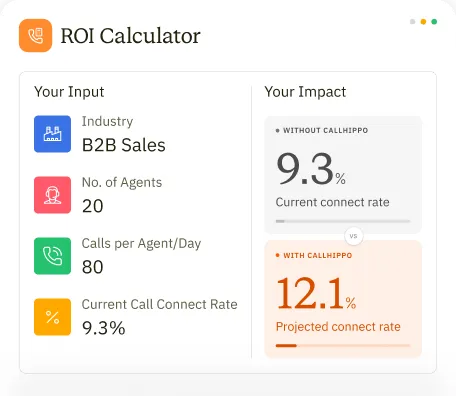
Plug in your team's dial volume, current connect rate, and average deal value. See your annual revenue impact in 60 seconds.
How to Choose the Best Google Voice Alternative
The right pick depends on how your team calls and what you expect from the phone.
1. Call Quality & Reliability
HD codecs and Tier 1 carrier routing matter more than any feature list. If calls drop, nothing else matters. Verify uptime SLAs before signing.
2. AI Calling Features
An AI calling platform with real-time transcription, call summaries, and voice agent capabilities saves managers hours of manual review. Ask what AI features come on the starter plan, not just the enterprise tier.
3. CRM & Helpdesk Integrations
A phone system without native HubSpot, Salesforce, or Zoho integration creates admin work every rep hates. Check integration depth beyond “compatible with,” which usually means Zapier only.
4. Scalability
Choose a platform that scales from 5 to 500 users without a rebuild. Ask about seat limits, contract terms, and how quickly new numbers activate globally.
5. Pricing Model
Per-seat pricing hides the real cost. Watch for per-minute overages, DID rental fees, feature paywalls, and annual contract requirements. Compare total cost of ownership, not sticker price.
6. Security & Compliance
For regulated industries, ask about SOC 2, GDPR, HIPAA, and TCPA compliance. Confirm data residency options if you operate across regions. Skip vendors that cannot show their certifications.
Google Voice vs CallHippo (Comparison Table)
Side by side, here is how CallHippo compares to Google Voice on every feature that matters for business use.
| Provider | Best For | Starting Price | Key Features | G2 Rating | |
|---|---|---|---|---|---|
| 1 | RingCentral | Enterprise UCaaS | $20/user/mo | Voice, video, messaging | |
| 2 | CallHippo | Global outbound sales | Free | 4 dialers, AI Copilot, 150+ countries | |
| 3 | OpenPhone (Quo) | Small collaborative teams | $15/user/mo | Shared inbox, texting-first | |
| 4 | Grasshopper | Solopreneurs | $14/mo | Mobile-based, no per-user cost | |
| 5 | Dialpad | AI-heavy teams | $15/user/mo | AI transcription, coaching | |
| 6 | Upfirst AI | Voice AI receptionists | $20/month | AI voice agents for inbound | |
| 7 | Ringly.io | AI voice automation | $349/mo | Voice AI, call automation | |
| 8 | Nextiva | Reliable UCaaS | $15/user/mo | 99.999% uptime, 24/7 support | |
| 9 | Ooma Office | Small business simplicity | $19.95/user/mo | 50+ standard features | |
| 10 | Aircall | HubSpot/Salesforce teams | $30/user/mo | Native CRM sync, power dialer | |
| 11 | Zoom Phone | Existing Zoom users | $16/user/mo | Single Zoom login |
Get access to global numbers, AI-powered features, and 100+ CRM integrations at business-ready pricing.
Take a 10-Day Free Trial No credit card required!Why CallHippo Is the Best Google Voice Alternative
CallHippo covers every gap Google Voice leaves for a business team. It does not just replace Google Voice; it upgrades every capability. Eight reasons the platform earns the top pick for growing businesses.
- Better international coverage: Virtual numbers in 150+ countries. Google Voice covers the US only.
- AI-powered communication: Real-time transcription, AI Copilot, and voice agents built in.
- Built for support and sales: Auto dialers, IVR, and routing designed for real business workflows.
- Affordable pricing: Entry plans start at $0/user/month.
- High call quality: Tier 1 carrier routing and HD codecs deliver crystal clear audio.
- CRM ecosystem: 100+ native integrations including HubSpot, Salesforce, and Zoho.
- Easy migration: Move existing numbers over with zero downtime.
- 24/7 support: Real support engineers answer chat, calls, and emails around the clock.
Conclusion
Google Voice fits a specific user: an individual who wants a second phone number. If you need auto dialing, global reach, AI features, or CRM sync, Google Voice hits its limit.
CallHippo is the strongest all-around Google Voice replacement for your business. For niche use cases, the other 10 alternatives fit different profiles. Match the tool to the way your team actually works.
Frequently Asked Questions
1. Is Google Voice still good for business use in 2026?
Google Voice remains a good fit for solo users and micro teams. For businesses running sales, support, or global operations, it falls short on features like auto dialing, CRM integration, and international numbers.
2. Can I port my Google Voice number to another provider?
Yes, Google Voice numbers can be ported to most business phone providers, including CallHippo. The process typically takes 2-4 weeks after submitting the porting request.
3. Which Google Voice alternative offers the best international calling?
CallHippo leads on international coverage with virtual numbers in 150+ countries. RingCentral, Dialpad, and Aircall each cover 50-100 countries. Google Voice offers limited outbound calling and US-only local numbers.
4. What is the best Google Voice alternative for remote teams?
CallHippo is the strongest pick for remote teams and businesses that need auto dialers, CRM sync, and global calling. Small remote teams also benefit from OpenPhone’s shared inbox or Zoom Phone’s unified login.
Published : July 14, 2026

Harsh Bairagi is a B2B SaaS content writer with over 4 years of experience in the tech industry. Harsh believes in creating good copies to bridge the gap between tech and emotion. When not chasing clean copy or clever metaphors, he is busy catching up on his favorite sports.

Subscribe to our newsletter & never miss our latest news and promotions.
 24k+ people have already subscribed